Synthetic DNA Data Storage & Molecular Computing: Solving the Exabyte Archival Crisis in 2026
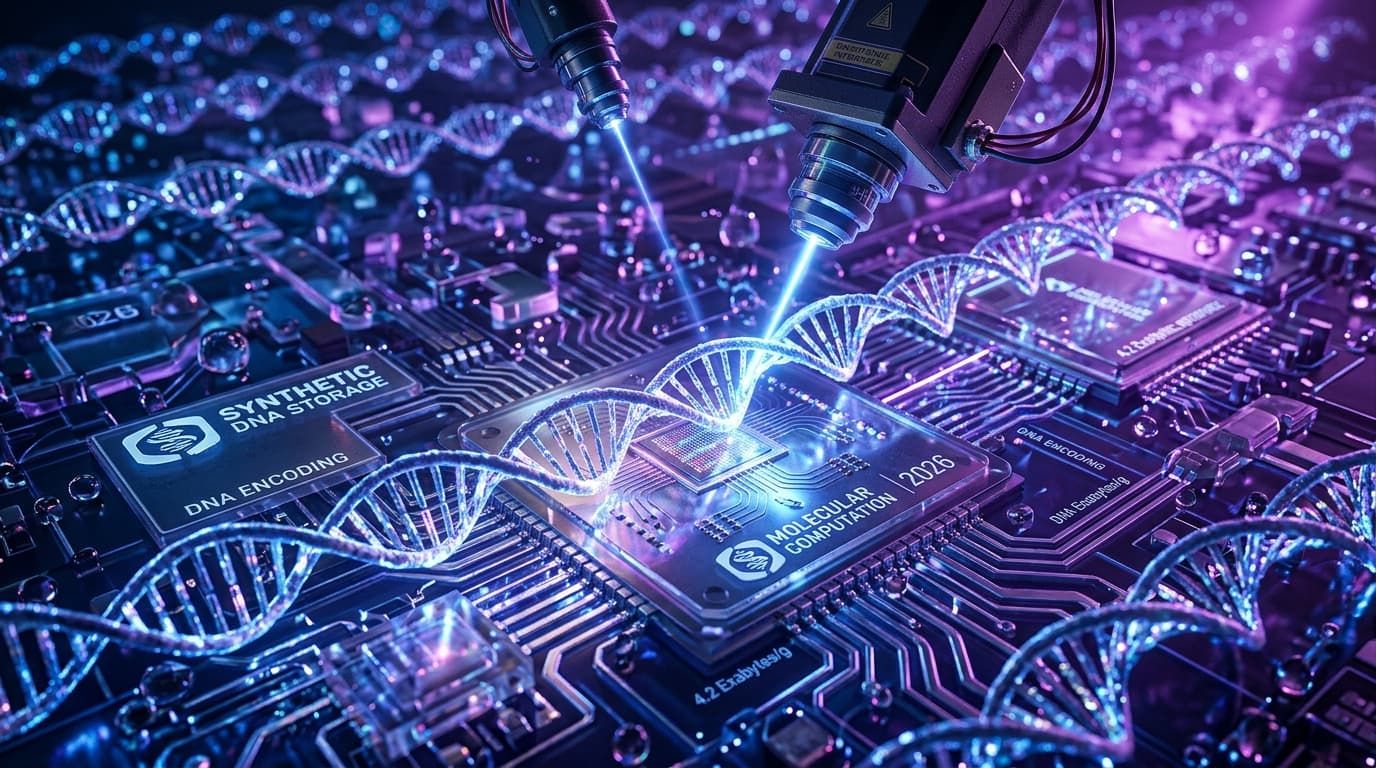
Quick Answer: The exponential surge of enterprise generative AI models and autonomous telemetry has pushed global data creation past 200 zettabytes, creating an unsustainable physical supply crisis for silicon NAND flash and magnetic tape. In 2026–2027, Synthetic DNA Data Storage and Molecular Computing have transitioned from biological research curiosities into commercial cold-archival solutions. By encoding digital binary bits (
0and1) into biological nucleotide base pairs (Adenine, Cytosine, Guanine, and Thymine), synthetic DNA delivers an extraordinary physical density of 215 petabytes per gram, retains data integrity for thousands of years without electric power, and executes massively parallel molecular search operations directly within the chemical substrate.
For over half a century, global datacenter architecture has depended on magnetic tape and spinning platters for cold archival storage. However, magnetic media physically degrades within 10 to 20 years, demanding costly, energy-intensive migration cycles across giant climate-controlled server warehouses.
Simultaneously, the raw material cost and supply-chain constraints of rare-earth metals in silicon lithography have created a physical ceiling. Enterprise datacenters are rapidly running out of physical land, clean electrical power, and cooling infrastructure solely to preserve archival compliance logs, medical genomic libraries, and generative AI training corpora.
Synthetic DNA fundamentally dissolves this constraint by leveraging four billion years of evolutionary data compression. A single teacup of synthetic DNA can theoretically store every piece of digital data ever created by human civilization.
Architectural Workflow: Binary-to-Biological Digital Storage Pipeline
To understand how synthetic DNA operates as a production storage tier, examine the molecular encoding, synthesis, and retrieval architecture:
Digital Binary Ingestion & Encoding:
[Digital File: Bits (01101001...)] ──► [Reed-Solomon / Fountain Code Compression]
                                               │
                                               ▼
                              [Quaternary Mapping: 00=A, 01=C, 10=G, 11=T]

Molecular Synthesis & Physical Cold Storage:
[Microfluidic Enzymatic Synthesizer] ──► Assembles physical DNA strands on silicon flow cells
                                               │
                                               ▼
[Lyophilized Room-Temperature Storage Pod] ──► 215 PB/gram, Zero-Power, 1,000+ Year Half-life

Data Retrieval & Molecular Computing:
[Magnetic Bead Affinity / PCR Primer Addressing] ──► Instant parallel search across billions of strands
                                               │
                                               ▼
[Solid-State Nanopore Sequencer] ──► Reads ionic electrical current variations
                                               │
                                               ▼
[Decoded Digital Binary File (Bit-Perfect Reconstruction)]
Strategic Comparison Matrix: Magnetic LTO Tape vs. Silicon NAND vs. Synthetic DNA
The table below contrasts the fundamental physical, economic, and operational metrics of legacy enterprise media against synthetic DNA storage:
| Storage Dimension | Enterprise LTO-9/10 Tape | 3D Silicon NAND Flash | Synthetic DNA Cold Storage (2026) |
|---|---|---|---|
| Physical Storage Density | ~1.5 × 10⁻⁴ Petabytes / gram | ~1.0 × 10⁻³ Petabytes / gram | 215 Petabytes per gram (Over 1M× denser) |
| Media Retention Lifespan | 15 to 30 years (degrades) | 5 to 10 years (charge leakage) | 1,000 to 10,000+ years (Stable in ambient dry pods) |
| Power Consumption during Rest | Moderate (climate/humidity controlled) | High (leakage refresh cycles) | Absolute Zero (Zero watts of operational power) |
| Raw Material Constraints | Cobalt, Barium Ferrite supply | Cobalt, Silicon, Gallium, Neodymium | Carbon, Nitrogen, Hydrogen, Oxygen, Phosphorus |
| Obsolescence Resistance | Tape formats obsolete every decade | Interface obsolescence (SATA/PCIe) | Universal (DNA reading will never become obsolete) |
| In-Memory Computational Ability | None (Requires external CPU/GPU) | Limited (SmartSSD computational storage) | Massive molecular search via complementary hybridization |
The 4 Core Breakthroughs Enabling DNA Storage in 2026–2027
Four pivotal technological transitions have allowed DNA storage to overcome historic cost and latency hurdles:
1. Enzymatic Synthesis Replacing Phosphoramidite Chemistry
Early DNA writing relied on harsh chemical phosphoramidite synthesis, which generated hazardous organic chemical waste and capped synthesis speeds. In 2026, semiconductor bio-foundries utilize engineered template-independent DNA polymerases (such as TdT) operating in benign aqueous solutions on CMOS micro-electrode arrays. This transition has accelerated synthesis speed by over 300% while cutting reagent expenses by an order of magnitude. (Explore our related research on Silicon Photonics and Optical Interconnects.)
2. Solid-State Nanopore Base-Calling
Reading DNA historically required expensive fluorescent optical sequencers and chemical dyes. Modern enterprise DNA storage racks utilize solid-state nanopore arrays: as single-stranded DNA is electrophoretically pulled through a microscopic nanoscale pore in a synthetic membrane, the distinct shape and charge of each base (A, C, G, T) modulates the ionic electrical current. Deep-learning base-callers decode gigabytes of raw data per second in real time. (Read our analysis on Neuromorphic Chips and Edge Computing.)
3. DNA Fountain Error Correction Codes (ECC)
Biological processes are non-deterministic; synthesis and sequencing can introduce dropouts, insertions, and base substitutions. Computer scientists have integrated advanced mathematical DNA Fountain codes and multi-dimensional Reed-Solomon algorithms. By distributing redundant mathematical packets across millions of short DNA oligos, files achieve bit-perfect data reconstruction even if 15% of the physical DNA strands are physically lost or degraded.
4. Molecular in-Memory Computing & Parallel Database Search
Unlike silicon storage where data must be shuttled over copper buses to a processor, DNA allows computation directly inside the storage tube. By designing complementary fluorescent or magnetic single-stranded DNA probes, researchers can execute associative database searches across billions of records simultaneously in seconds, exploiting Watson-Crick base-pairing affinity to filter and isolate matching data without reading the entire archive. (Explore our guide on Quantum Computing Breakthroughs.)
Enterprise Use Cases: Where Synthetic DNA is Deployed Today
Hyperscale cloud providers, national libraries, and biomedical enterprises are deploying commercial DNA archival pilots across three critical domains:
- Sovereign Legal & Regulatory Vaults: Financial compliance frameworks (such as SEC and Basel III) require financial institutions to retain unalterable records for decades. DNA pods stored in inert nitrogen eliminate the threat of magnetic erasure, electromagnetic pulse (EMP) destruction, or multi-decade media migration expenses.
- AI Foundation Model Lineage Archiving: As trillion-parameter model weights and petabyte-scale training datasets become multi-billion-dollar enterprise assets, companies store frozen snapshots of historic model checkpoints in synthetic DNA, safeguarding against data rot and catastrophic cloud outages. (Explore our macro analysis on Sovereign AI Infrastructure as an Asset Class.)
- Genomic and Historical Cultural Heritage: National archives and medical research institutions are preserving fragile cultural media, manuscripts, and population health genomes within biological DNA crystals capable of surviving environmental catastrophes.
Frequently Asked Questions (FAQ)
How is digital binary data (0s and 1s) physically converted into biological DNA?
Digital binary data consists of bits (0 and 1). Software encoders group these bits into two-bit pairs (00, 01, 10, 11) and map them directly to the four nucleotide chemical bases of DNA: Adenine (A), Cytosine (C), Guanine (G), and Thymine (T). A DNA synthesizer then chemically builds synthetic oligonucleotides base-by-base in that precise digital order.
Why doesn't synthetic DNA rot or spoil like living biological tissue?
Living tissue rots because bacteria, fungi, and active enzymatic nucleases break down cellular structures in the presence of water, heat, and oxygen. Synthetic DNA used for data storage is dehydrated (lyophilized), purified of biological proteins, and sealed inside stainless steel or glass capsules with inert nitrogen gas. In this inert state, DNA possesses a chemical half-life exceeding 1,000 to 10,000 years at room temperature.
Is synthetic DNA storage intended to replace SSDs or RAM in consumer computers?
No. Synthetic DNA is engineered specifically as a deep cold archival storage tier, replacing magnetic LTO tape and long-term hard drives. Because synthesizing and sequencing DNA takes minutes to hours, it is not suitable for "hot" storage like operating systems or real-time application memory, which still rely on ultra-fast silicon DRAM and NVMe SSDs.
How much physical space would be saved by migrating a cloud datacenter to DNA?
The physical reduction is astronomical. A multi-acre hyperscale datacenter housing millions of magnetic tape cartridges and hard drive racks can theoretically be consolidated into a desktop-sized storage cabinet containing microscopic vials of synthetic DNA, cutting physical footprint and HVAC refrigeration power by over 99%.
Related Articles
Silicon Photonics and Optical Interconnects: Overcoming the AI Datacenter Bandwidth & Power Wall in 2026
Physical AI and Autonomous Humanoid Robotics: The Industrial Manufacturing Shift in 2026–2027