Sovereign AI Infrastructure: The New Macroeconomic Asset Class Rewiring Global Capital
Throughout the 20th century, sovereign power and macroeconomic hegemony were anchored in physical resource dominance: crude oil reserves, steel production pipelines, and maritime choke points. In 2026, the fulcrum of geopolitical leverage has shifted into a new domain: Sovereign AI Compute.
Global superpowers, regional federations, and forward-looking nation-states are pouring hundreds of billions of dollars into domestic computing clusters, high-voltage clean energy campuses, and territorial data vaults. Compute is no longer viewed as an IT operating expenditure; it is officially recognized by international monetary institutions and sovereign wealth funds as a Tier-1 macroeconomic asset class akin to gold or strategic petroleum stockpiles.
The Pillars of Sovereign Compute Architecture
Why are sovereign entities choosing to construct ultra-capital-intensive domestic infrastructure rather than relying on hyper-scalable commercial public clouds? The rationale spans national defense, legal autonomy, and digital independence.
1. Data Border Enforcement and Jurisdictional Integrity
Relying on foreign commercial clouds exposes sovereign nations to extraterritorial regulatory reach, foreign surveillance acts, and sudden cross-border embargoes. Sovereign AI infrastructure ensures that domestic citizen data, tax records, genetic registries, and proprietary military intelligence remain locked within sovereign territory, governed exclusively by local legal jurisprudence.
2. Cultural, Linguistic, and Historical Alignment
General commercial foundation models trained predominantly on western internet corpora carry implicit linguistic, cultural, and ideological biases. Sovereign initiatives—such as bilingual and specialized Arabic, Japanese, or Nordic models—require dedicated clusters to train foundational weights that reflect national values, historical documentation, and institutional nuances.
3. Supply Chain Insulation and Compute Arbitrage
Geopolitical sanctions and export restrictions on advanced semiconductor accelerators have proved that compute supply can be weaponized overnight. Sovereign stockpiles of domestic tensor processors ensure continuity of government operations, public healthcare triage, and critical financial clearinghouses during international trade disruptions.
The Energy-Data Nexus: Small Modular Reactors (SMRs) and Clean Grids
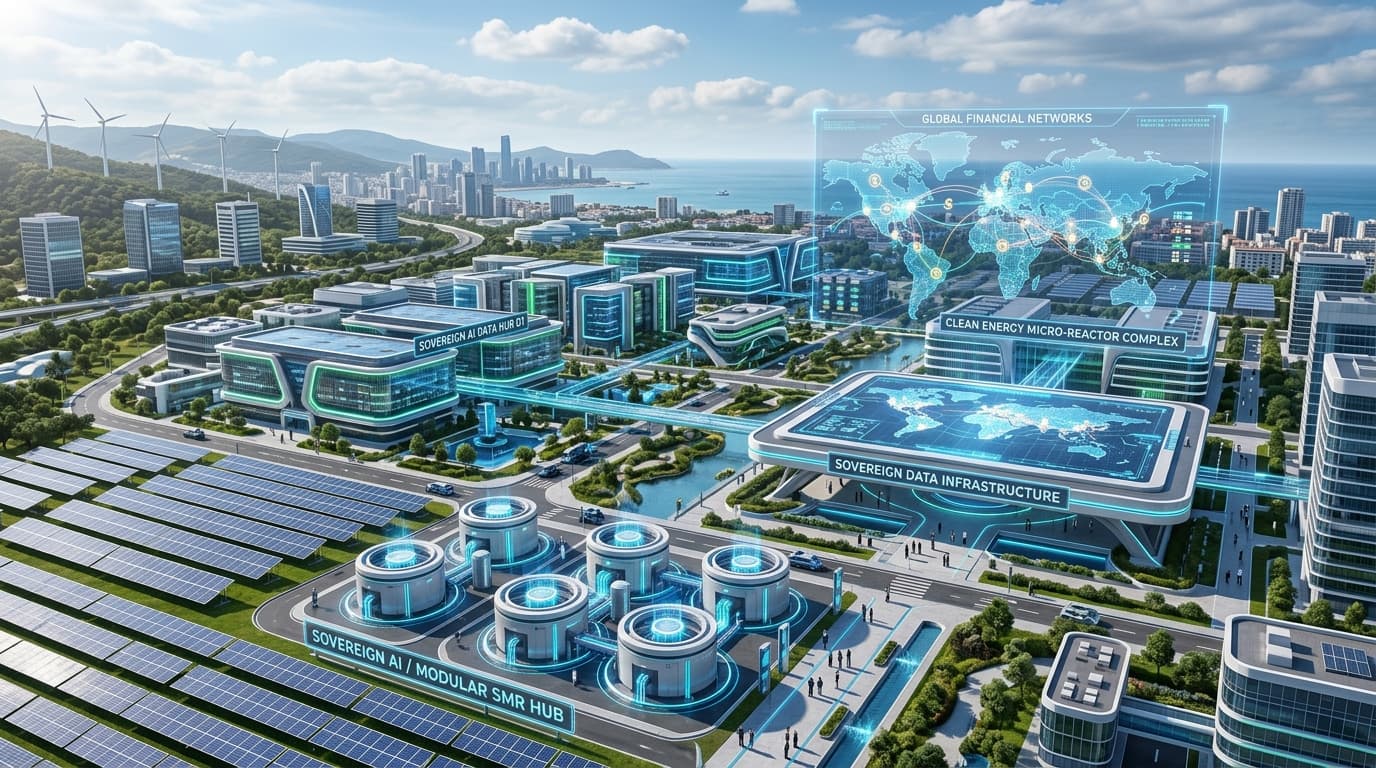
The most significant bottleneck in sovereign AI expansion is no longer chip availability, but electrical grid capacity. A gigawatt-scale AI training cluster consumes electricity equivalent to an entire metropolitan area.
To circumvent overloaded municipal energy grids, sovereign developers and institutional asset managers are pioneering direct-wire energy integration:
- Small Modular Nuclear Reactors (SMRs): Dedicated 50MW to 300MW micro-reactors co-located directly behind the meter of sovereign datacenter compounds, ensuring 99.999% baseload uptime insulated from public grid fluctuations.
- Geothermal and Hydroelectric Baseload Integration: Nations such as Iceland, Norway, and Chile are monetizing natural tectonic and glacial water resources by transforming raw green energy directly into high-value sovereign compute exports.
- Waste Heat Municipal Recirculation: Datacenter thermal discharge is channeled into municipal district heating systems, transforming compute facilities into civic heating utilities.
Enterprise Implications: Navigating the Multi-Sovereign Cloud
For multinational corporations, the rise of sovereign AI fundamentally transforms global enterprise risk management:
| Dimension | Legacy Globalized Public Cloud | Emerging Sovereign Multi-Jurisdictional Architecture |
|---|---|---|
| Capital Allocation | Pure OpEx via multi-tenant vendor | Hybrid CapEx/OpEx via local joint ventures and public-private partnerships |
| Compliance Risk | Unified terms of service across territories | Strict localization mandates (local training, local residency, local audit) |
| Vendor Resilience | Single point of failure across dominant providers | Geo-distributed redundancy across sovereign-compliant nodes |
| Model Customization | Generic API endpoints with system prompt guardrails | Sovereign base models fine-tuned with verified territorial datasets |
Strategic Outlook
As sovereign compute clusters mature, global financial markets are beginning to securitize compute capacity. From tokenized compute credits traded on decentralized exchanges to sovereign compute bonds backed by treasury guarantees, the convergence of national sovereignty, electrical grid infrastructure, and artificial intelligence represents the most significant capital reallocation cycle of the decade.
Frequently Asked Questions (FAQs)
What is Sovereign AI and why are nations investing in it?
Sovereign AI refers to a nation's strategic capability to build, own, and control its physical artificial intelligence infrastructure—including domestic compute clusters, local foundation models, and sovereign data vaults. Nation-states invest heavily in sovereign AI to protect national defense intelligence, safeguard cultural and linguistic integrity, and prevent economic paralysis caused by foreign export bans or sanctions.
Why are nuclear Small Modular Reactors (SMRs) becoming essential for AI data centers?
Gigawatt-scale AI computing campuses consume massive amounts of continuous baseload electricity that can overwhelm municipal public grids. SMRs provide dedicated, zero-carbon, behind-the-meter nuclear power with 99.999% uptime, completely insulating critical sovereign compute clusters from public electrical grid fluctuations or regional power brownouts.
How does sovereign AI infrastructure impact multinational corporations?
Enterprises operating globally can no longer rely on a single centralized public cloud vendor. Multinational organizations must adopt multi-sovereign hybrid cloud architectures that comply with strict territorial data residency mandates, localized AI model training requirements, and jurisdictional governance across each country of operation.