Physical AI and Autonomous Humanoid Robotics: The Industrial Manufacturing Shift in 2026–2027
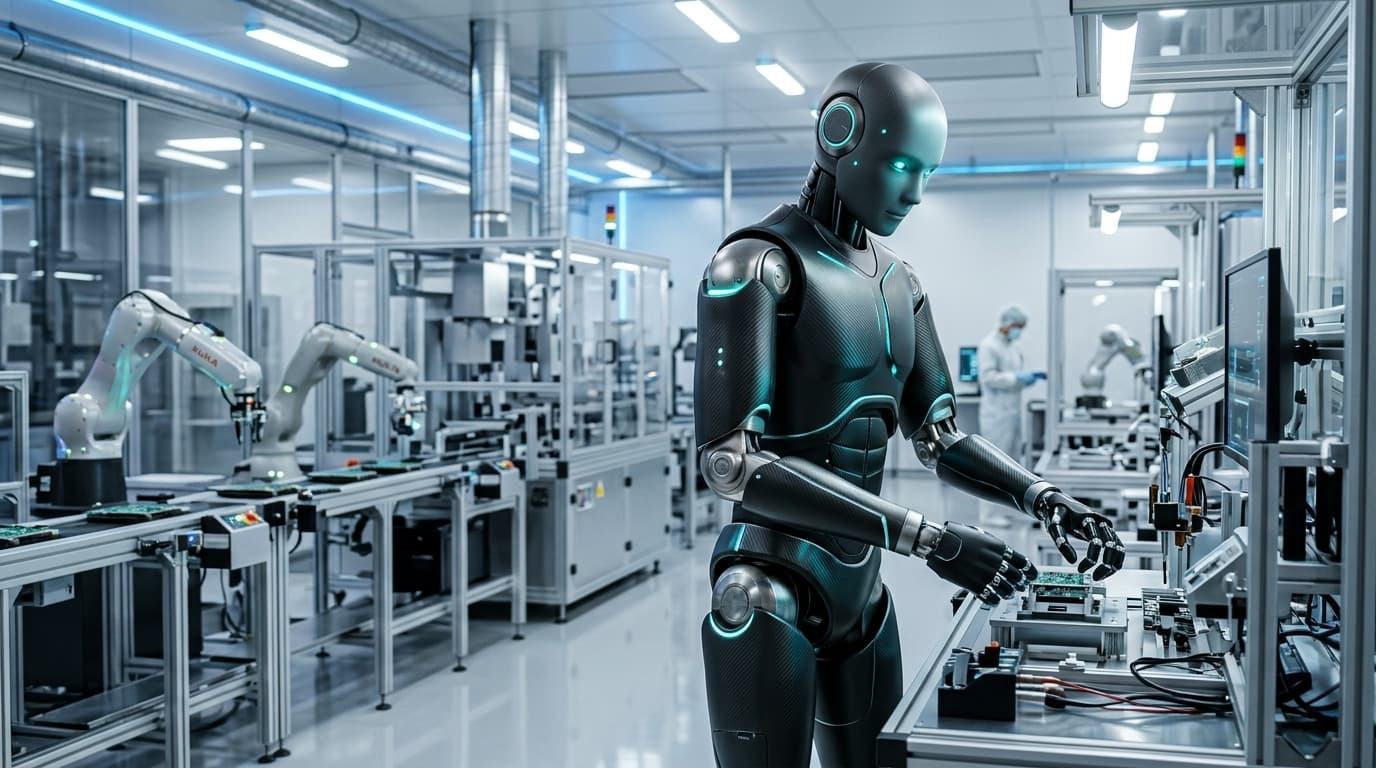
Quick Answer: The convergence of Physical AI and commercial bipedal humanoid robots represents the most significant manufacturing disruption since robotic automotive arms in the 1970s. Unlike legacy fixed industrial robots that require rigid safety cages and isolated programming, 2026–2027 humanoid platforms (such as Figure 02, Tesla Optimus Gen 3, and Boston Dynamics Atlas) leverage multi-modal Vision-Language-Action (VLA) foundation models. These autonomous systems interpret unscripted 3D spatial environments in real time, generalize motor policies across variable assembly tasks, and safely collaborate alongside human factory technicians without custom hardware retooling.
For more than five decades, industrial automation was defined by precision, rigidity, and high capital expenditure. Heavy six-axis robotic arms bolted to factory floors excelled at performing single repetitive tasks millions of times with sub-millimeter tolerances. However, any deviation in part positioning, lighting, or factory floor geometry caused entire assembly lines to halt.
In 2026–2027, the manufacturing landscape is experiencing a paradigm shift driven by Physical Artificial Intelligence—the embodied integration of neural networks with physical robotic actuators and tactile end-effectors. Humanoid robots are transitioning from viral lab demos into commercial pilot deployments across automotive assembly, semiconductor packaging, and aerospace supply chains.
The Architectural Evolution: Fixed Automation vs. Embodied Physical AI
To understand why enterprise manufacturers are investing billions into humanoid fleets, we must contrast traditional automation paradigms with embodied neural architectures:
Legacy Industrial Robotics (Rule-Based & Rigid):
[Rigid Scripted Program] ──► [Fixed Six-Axis Arm] ──► [1 Exact Repeatable Motion] ──► (Fails on 1mm Deviation)

Embodied Physical AI (VLA Foundation Models):
[Multi-Camera Spatial Perception + Tactile Sensor Array]
                           │
                           ▼
[Multi-Modal Vision-Language-Action (VLA) Model]
                           │
                           ▼
[Real-Time Trajectory Optimization & Dynamic Motor Torque Adjustment]
                           │
                           ▼
[Adaptive End-Effector Action (Zero-Shot Object Manipulation)]
Strategic Comparison Matrix: Leading Humanoid Robotics Platforms (2026–2027)
The following matrix compares top commercial humanoid platforms actively operating in enterprise pilot facilities:
| Platform & Manufacturer | Primary Actuation Architecture | Compute & Inference Engine | Degrees of Freedom (DoF) | Continuous Runtime | Primary Industrial Deployment |
|---|---|---|---|---|---|
| Figure 02 (Figure AI) | Integrated electromechanical custom actuators | Onboard dual high-performance neural NPU | 40+ total DoF (16 DoF dexterous hands) | ~5 hours (swappable battery) | Automotive sheet metal placement & logistics |
| Tesla Optimus Gen 3 | Planetary roller screw & rotary actuators | Tesla custom FSD/HW4 inference computer | 28 structural DoF + 22 DoF hands | ~8 hours continuous shift | Battery pack assembly & factory parts distribution |
| Boston Dynamics Atlas | Fully electric high-torque rotary actuators | Centralized real-time perception server | Full biological human range of motion | ~4 to 5 hours | Heavy industrial sorting, lifting & hazardous maintenance |
| Agility Robotics Digit | Hybrid bipedal kinematic linkage | Edge perception & cloud fleet orchestration | Tailored for tote manipulation | ~6 hours | E-commerce fulfillment & warehouse cross-docking |
Core Technological Breakthroughs Powering Physical AI
Three foundational breakthroughs enabled humanoid robotics to transition from clumsy research prototypes into commercially viable factory operators:
1. Vision-Language-Action (VLA) Neural Models
Early robots required explicit kinematic coordinate equations for every millimeter of arm movement. In contrast, VLA models take high-resolution stereoscopic visual feeds and natural language task instructions (e.g., "Retrieve the aluminum heat sink, orient the thermal pads upward, and seat it into the chassis bracket"), directly emitting low-level motor torque commands at 200 Hz. Because VLA models are pre-trained on millions of synthetic simulation hours in physics engines like NVIDIA Isaac Sim, robots demonstrate zero-shot generalization when handling new packaging shapes or altered lighting.
2. High-Density Tactile Sensing and Dexterous Manipulation
Human hands possess thousands of mechanoreceptors capable of discerning slippage, texture, and shear force within milliseconds. Next-generation robotic hands incorporate high-density elastomeric optical tactile arrays and micro-strain gauges across fingertips. This allows a humanoid robot to handle fragile lithium-ion pouch cells without puncturing delicate polymer membranes, and seamlessly switch to tightening high-torque chassis fasteners. (Read our analysis on Edge AI in Autonomous Systems.)
3. Energy-Dense Solid-State Battery Integration
Previous hydraulic and electric humanoids suffered from limited 60-to-90-minute runtimes, requiring frequent downtime. The adoption of semi-solid and solid-state battery packs integrated directly into the robot's pelvic chassis has doubled gravimetric energy density, extending operational shifts to 5–8 hours on a single charge with rapid inductive dock replenishment. (Explore our comprehensive review of Solid-State Batteries and EV Evolution.)
Economic ROI: Calculating Humanoid Factory Economics
For plant managers and Chief Operating Officers, the deployment calculus boils down to total cost of ownership (TCO) versus human labor and conventional automation:
- Hardware-as-a-Service (HaaS) Pricing: Most humanoid vendors have adopted an hourly service model rather than requiring $150,000+ upfront capital. Enterprises pay an operational rate of $18 to $25 per operating hour, which covers hardware leasing, fleet orchestration software, preventative maintenance, and continuous over-the-air (OTA) neural weight updates.
- Brownfield Compatibility: Traditional automation requires redesigning entire factory layouts, tearing up concrete floors, and erecting protective safety fencing. Humanoid robots are designed to operate within human-scale infrastructure: using standard staircases, walking through 36-inch factory doors, and utilizing identical assembly fixtures designed for human operators.
- Ergonomic Injury Elimination: Deploying humanoid robots to handle repetitive high-strain tasks (such as overhead underbody chassis sealant application and heavy battery tote transfers) eliminates multi-million-dollar workers' compensation claims and addresses critical demographic manufacturing labor shortages in aging economies.
Frequently Asked Questions (FAQ)
What distinguishes a humanoid robot from traditional industrial automation arms?
Traditional robotic arms are permanently bolted to single workstations and require rigid, pre-programmed code with zero environmental flexibility. In contrast, humanoid robots possess bipedal mobility, omnidirectional vision, and Physical AI (VLA models), allowing them to navigate dynamic factory floors, inspect unexpected obstacles, and perform varied tasks using human-designed tools and workstations without custom infrastructure retooling.
Are humanoid robots safe to work alongside human factory employees?
Yes. Modern humanoid systems incorporate multi-layered safety architectures including compliance-controlled soft actuators, redundant LiDAR and time-of-flight depth cameras, and real-time collision prediction neural networks. If an operator unexpectedly steps into the robot's movement path, the actuator torque drops to zero within 15 milliseconds, safely stopping all motion before physical impact occurs.
What are the biggest operational bottlenecks facing humanoid deployment today?
The primary technical bottlenecks in 2026 are edge inference latency during complex unstructured dexterous manipulations, thermal dissipation in compact rotary actuators under continuous heavy payloads, and standardized safety certification frameworks across different regulatory jurisdictions (such as OSHA and EU Machinery Regulations).
How does Physical AI impact manufacturing labor markets?
Rather than causing sudden mass unemployment, humanoid robotics addresses chronic industrial labor deficits in developed nations. Robots take over repetitive, ergonomically hazardous, third-shift, and high-heat tasks, while human technicians are upskilled into robotic fleet coordinators, maintenance specialists, and quality control supervisors.