Small Language Models (SLMs) on Everyday Devices in 2026: Why Bigger Isn't Always Better
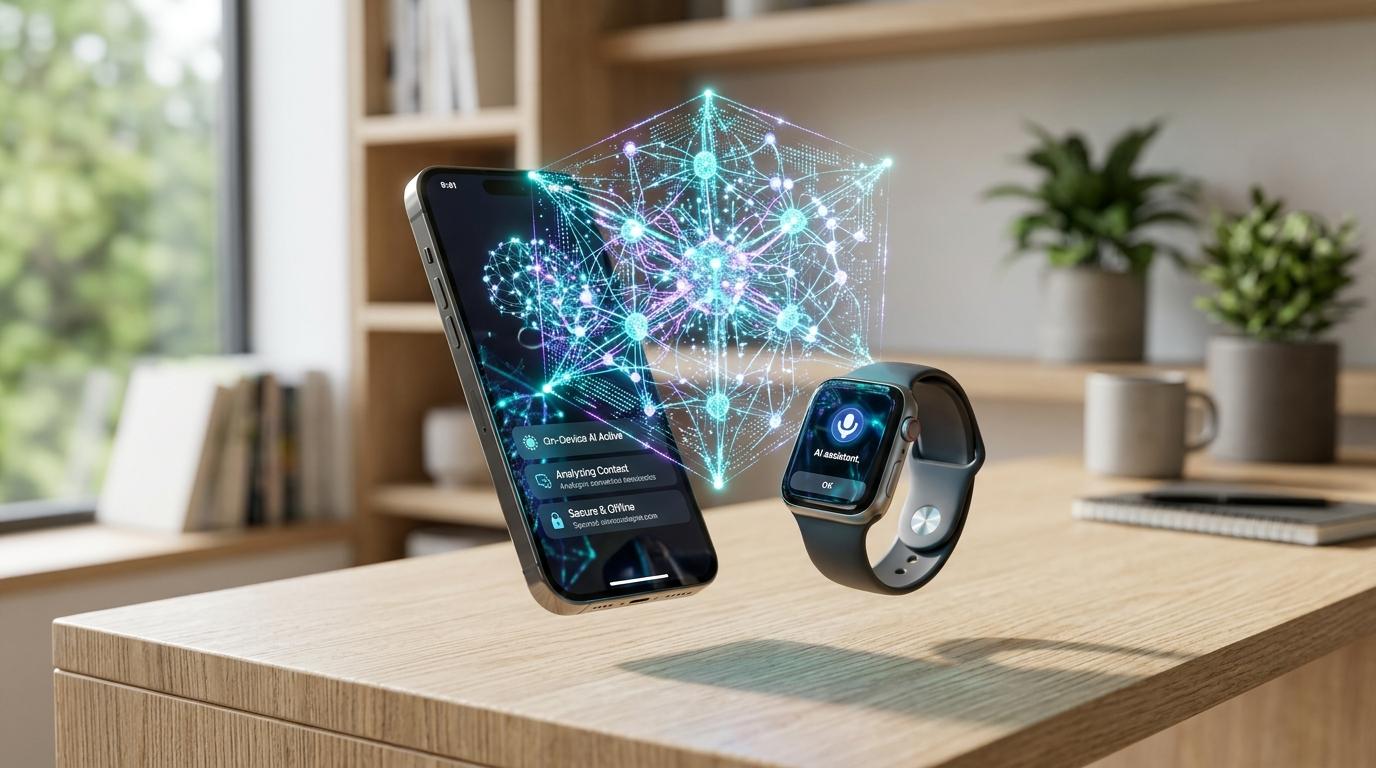
1. What Are Small Language Models (SLMs)?
For years, the artificial intelligence race was defined by a simple slogan: bigger is better. Giant models with hundreds of billions of parameters dominated the headlines. However, using a 500-billion parameter model to format a grocery list or translate a short voice note is like driving an 18-wheel cargo truck to the local supermarket to pick up a carton of milk. It works, but it wastes tremendous energy and money.
Small Language Models (SLMs) are purpose-built neural networks typically trained with between 1 billion and 7 billion parameters. Rather than attempting to memorize every historical fact on the internet, they are trained on highly curated, high-quality "textbook-grade" data.
By 2026, advances in architectural efficiency (such as 4-bit INT4 quantization and pruned state-space layers) allow a 2-billion parameter model to match or beat the reasoning performance of 2023's largest cloud models, all while fitting inside 1.5 gigabytes of phone memory.
2. Why Bigger Isn't Always Better in Everyday Life
While massive cloud foundation models remain vital for drug discovery and complex scientific research, everyday consumers and professionals benefit far more from local SLMs. Here are the three main reasons why:
1. Instant Speed and No Cloud Waiting Queues
When you speak to a cloud-based voice assistant, your voice is compressed, beamed over 5G to a distant server, placed into an API processing queue, processed, and beamed back. This introduces a noticeable 1-to-3 second lag.
A local SLM processes audio and tokens directly on your device's Neural Processing Unit (NPU). Words appear on your screen the millisecond you finish speaking, creating a seamless, natural conversational flow.
2. True Data Sovereignty and Peace of Mind
Privacy has become a major concern for digital users worldwide. When you paste confidential business contracts, family budget spreadsheets, or health symptoms into a cloud chatbot, you surrender control over that information.
With an on-device SLM, airplane mode can be switched on, Wi-Fi can be disabled, and the model functions with complete fluency. Your sensitive data never touches an external server, advertising algorithm, or third-party training pipeline.
3. Reliable Offline Independence
Whether you are on a long international flight, hiking in a mountain valley, or riding a subway with poor cellular reception, your digital assistant continues to work effortlessly. You can draft emails, organize notes, and translate foreign menus completely offline.
3. Cloud LLMs vs. On-Device SLMs: A Direct Comparison
The table below highlights the practical differences between traditional cloud-hosted AI and modern 2026 on-device SLMs:
| Key Feature | Traditional Cloud AI (LLM) | 2026 On-Device Model (SLM) |
|---|---|---|
| Model Size | 70B to 1 Trillion+ Parameters | 1B to 4B Parameters |
| Internet Requirement | Continuous high-speed connection | Zero internet required (100% offline) |
| Response Latency | 800ms - 2,500ms | Under 35ms (Instant streaming) |
| Data Privacy | Data transmitted to external cloud | Data stays 100% on your device |
| Monthly Subscription | $20 to $50 per month recurring | Free & open-source (One-time download) |
| Hardware Required | Cloud GPU datacenters | Standard modern smartphone or laptop |
4. How Modern Phones and Laptops Run AI Locally
How is it possible for a sleek smartphone in your pocket to run an intelligent language model without overheating?
In 2026, three hardware and software innovations made this possible:
- Dedicated Neural Processing Units (NPUs): Modern mobile processors (such as Apple's A19, Qualcomm's Snapdragon 8 Elite Gen 2, and Intel Core Ultra) include dedicated silicon circuits engineered specifically for matrix math. These NPUs execute AI calculations using a fraction of the electricity required by traditional CPUs.
- Extreme Model Quantization (INT4 & FP4): Originally, AI models stored numbers using 16-bit or 32-bit floating points. By compressing these values into 4-bit integers with zero loss in practical accuracy, developers shrank the file size from 16 gigabytes down to just 1.8 gigabytes.
- Speculative Decoding: Your device uses an ultra-tiny "draft model" (250 million parameters) to guess the next few words rapidly, and the main 2-billion parameter model verifies them in parallel. This doubles typing speed while keeping battery consumption minimal.
5. Practical Everyday Use Cases for On-Device SLMs
Here are four simple ways everyday users are leveraging SLMs in 2026:
1. Real-Time Meeting Summaries Without Recording Uploads
During client Zoom calls or private meetings, local models transcribe audio locally, generate action item checklists, and file them into your calendar without uploading corporate audio to third-party transcription services.
2. Context-Aware Smart Keyboard & Writing Copilot
Rather than suggesting just the next word, your mobile keyboard understands the entire email conversation and can draft polite, context-appropriate replies in your personal tone with a single tap.
3. Instant Photo and Document Search
Ask your phone: "Find the receipt for the blue jacket I bought in Milan last summer," and the on-device model searches your receipts, photos, and messages locally in seconds without cloud image scanning.
4. Private Health and Workout Tracking
Your smartwatch and fitness apps process sleep heart-rate data and nutrition logs on your wrist, providing customized recovery advice without sharing private biometrics with insurance firms.
6. How to Get Started with Local AI Today: 4 Simple Steps
You do not need to be a software engineer to experience the benefits of local SLMs. Follow this simple checklist to try local AI on your own hardware today:
- Step 1: Check Your Hardware: If you have an iPhone 15 Pro or newer, a modern Android phone with 8GB RAM, or a laptop from 2024 or later, your device is fully equipped.
- Step 2: Download a Friendly Local Runner: Install free, user-friendly desktop applications such as LM Studio, Jan.ai, or Ollama. On mobile, apps like Private LLM or PocketLLM work with one click.
- Step 3: Select a Balanced SLM: Choose top-rated lightweight models such as Phi-4 Mini (3.8B), Gemma 2 (2B), or Llama 3.2 (3B). These download in under two minutes.
- Step 4: Test in Airplane Mode: Disconnect your internet connection, ask a question or request a document summary, and watch how quickly and privately your device responds.
7. Frequently Asked Questions (FAQ)
Will running an SLM drain my smartphone battery quickly?
No. Because modern chips offload AI math to dedicated low-power NPUs, generating a typical 300-word summary consumes less than 0.2% of your phone's battery.
Are Small Language Models as smart as ChatGPT or Claude?
For focused tasks—such as summarization, grammar editing, coding assistance, and translation—SLMs perform nearly identically to massive cloud models. Massive models are only needed when you require vast historical trivia or highly specialized scientific paper analysis.
Do I have to pay a monthly subscription for local SLMs?
No. Local models are open-weights and run entirely on your own hardware. Once downloaded, they are completely free forever, with zero subscription fees or token costs.
Can an on-device model update its knowledge over time?
Yes. Modern SLMs connect to your personal notes, emails, and browsing history through local search indexes (Local RAG), meaning your assistant stays current with your personal life without needing retraining.
8. Conclusion: The Smart, Private Future of AI
The future of artificial intelligence is not about building ever-larger data centers that consume city-sized power grids. The real personal revolution is about making intelligence compact, personal, and invisible.
By moving everyday computing tasks to fast, private, and efficient Small Language Models, you regain full control over your digital life. You get instantaneous answers, preserve your battery, and safeguard your personal privacy—proving that in the world of personal technology, bigger is rarely better.
Author Bio: Dr. Elena Vance, Ph.D., is a Senior AI Systems Researcher at Nizover specializing in on-device machine learning, efficient neural architectures, and edge computing.
Level Up Your AI & Solo-Founder Strategy
Join 15,000+ founders and engineers getting our field-tested playbooks on autonomous agents, Micro-SaaS architecture, and lean financial frameworks every Thursday.

Specialist in quantum computing, neural networks, and next-generation computational architectures with over 12 years of research and industry consulting experience.
Related Articles
Post-Transformer Recurrent Architectures in 2026: Linear Attention, RWKV-v7, and Infinite-Context Edge Intelligence
Autonomous Coding Agents and the Model Context Protocol (MCP) in 2026: The End of Static IDE Autocomplete
Liquid Neural Networks (LNNs) in 2026: Continuous-Time AI for Autonomous Edge Robotics