Neuromorphic Computing and Event-Based Silicon: The Hardware Architecture Surpassing GPUs at the Edge
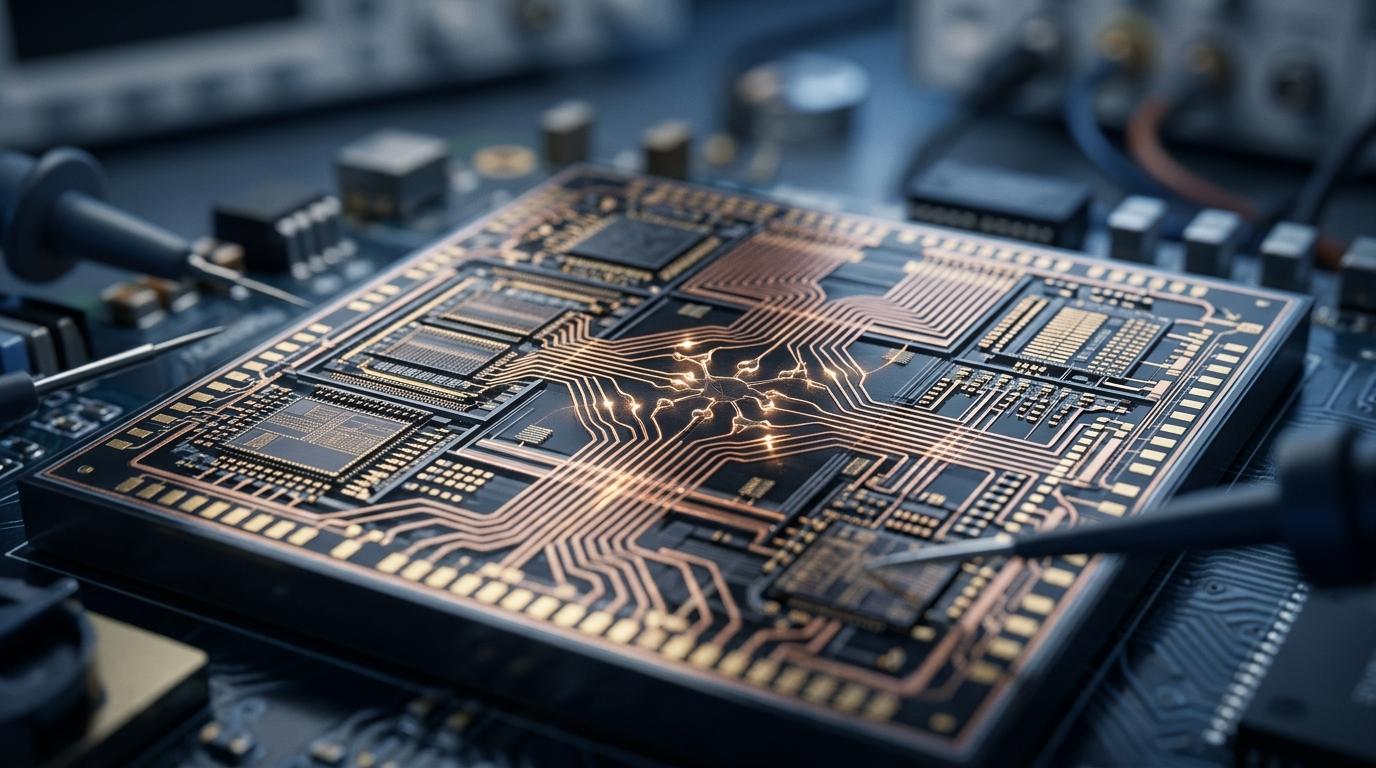
Conventional synchronous computing architectures are encountering insurmountable thermodynamic and bandwidth bottlenecks in real-time edge environments. Neuromorphic processors and event-driven silicon discard traditional clock cycles, processing information only when physical state changes occur. By emulating biological spike timing, neuromorphic systems achieve microsecond latency envelopes and significant reductions in energy consumption compared to conventional GPUs.
1. The Clock-Cycle Bottleneck in Physical Intelligence
Modern artificial intelligence was built on dense matrix multiplication executed across massively parallel GPU clusters. While synchronous tensor processing excels at batch training large language models in climate-controlled data centers, it faces severe fundamental constraints when deployed in autonomous physical environments.
Robots, autonomous vehicles, and industrial drones do not operate on batch queues. They interact with continuous, dynamic physics where waiting 20 to 50 milliseconds for sensor frames to aggregate introduces unacceptable drift and collision hazards.
Furthermore, conventional computer vision operates on rigid frame rates. A standard 60-frame-per-second camera continuously captures and streams every pixel, regardless of whether anything in the environment moved. This produces enormous amounts of redundant data, generating excess heat and rapidly draining onboard batteries.
Neuromorphic computing resolves this inefficiency by taking inspiration from the mammalian nervous system. Human sensory organs do not transmit complete static snapshots of the visual field 60 times a second; instead, individual retinal cells fire electrical impulses (spikes) exclusively when changes in local luminance occur.
2. Fundamentals of Event-Based Processing and Spiking Neural Networks
To understand neuromorphic hardware, one must differentiate between synchronous deep learning networks (ANNs) and asynchronous Spiking Neural Networks (SNNs).
Synchronous GPU Pipeline (Dense, Frame-Bound):
[Camera Sensor] ---> [Fixed 60fps Frame] ---> [Dense Matrix GEMM Engine] ---> [Output State]
(High continuous power, 15-40ms latency, 95% redundant static data)

Neuromorphic SNN Pipeline (Sparse, Asynchronous):
[Event Sensor] ----> [Microsecond Spike Stream] ---> [Sparse Synaptic Mesh] ---> [Instantaneous Action]
(Milliwatt idle power, <1ms reaction, zero redundancy during stillness)
In standard artificial neural networks, activation values are real continuous numbers passed simultaneously across layers at each forward pass. In Spiking Neural Networks, communication occurs via discrete binary events called spikes.
The Leaky Integrate-and-Fire Model
At the silicon level, neuromorphic architectures implement variants of the Leaky Integrate-and-Fire (LIF) neuron equation:
$$\tau_m \frac{du(t)}{dt} = -(u(t) - u_{\text{rest}}) + R \cdot I(t)$$
When input spikes arrive through synaptic connections, the membrane potential $u(t)$ increases. If the membrane potential crosses a set threshold, the physical neuron fires an outgoing spike to downstream neighbors and immediately resets. If no external stimuli arrive, the potential leaks back down toward its baseline resting state.
Because computation only occurs when a spike arrives, inactive regions of the chip consume virtually zero dynamic power. This property, known as temporal sparsity, is the fundamental mechanism behind neuromorphic energy efficiency.
3. Neuromorphic Silicon vs. Conventional Edge GPUs
The table below contrasts standard edge GPUs (such as the NVIDIA Jetson series) against dedicated neuromorphic processors (such as Intel Loihi, SynSense Xylo, and BrainChip Akida):
| Architectural Dimension | Conventional Edge GPU (Synchronous) | Neuromorphic Silicon (Event-Driven) |
|---|---|---|
| Clock Architecture | Global synchronous master clock (1.2 - 2.5 GHz) | Fully asynchronous / event-driven |
| Data Representation | 16-bit / 8-bit floating point dense tensors | Discrete 1-bit temporal spikes |
| Memory Architecture | Von Neumann (separated compute and SRAM/DRAM) | Co-located in-memory compute / distributed synapses |
| Active Power Draw | 15 Watts to 60+ Watts | 50 Milliwatts to 1.5 Watts |
| Static Idle Power | Substantial (continuous clock distribution) | Near zero leakage power |
| End-to-End Latency | 15 to 45 milliseconds (frame capture latency) | Sub-millisecond (microsecond spike latency) |
| Dynamic Range | 60 to 70 dB (sensor saturation in bright light) | >120 dB (handles extreme glare and pitch darkness) |
4. Neuromorphic Vision: Moving Beyond the Camera Frame
A computing architecture is only as fast as its primary data inputs. The true catalyst for neuromorphic hardware adoption has been the maturation of Event-Based Dynamic Vision Sensors (DVS) developed by companies such as Prophesee and Sony.
Unlike standard CMOS image sensors that expose rows of pixels simultaneously, each pixel in a DVS sensor operates as an autonomous circuit. When the logarithmic illumination on a specific pixel changes beyond a tunable threshold, it immediately emits a lightweight data packet containing:
- Exact X and Y pixel coordinates
- Microsecond-accurate timestamp
- Polarity sign (+1 for brightness increase, -1 for decrease)
Because an event sensor captures temporal changes rather than entire frames, its effective temporal resolution exceeds 10,000 frames per second equivalent, while producing 90% less raw data bandwidth than a conventional high-speed camera. In high-speed robotic manipulation or high-speed drone navigation through dense forest canopies, event sensors detect obstacles and surface deviations before a standard frame-based camera can even finish its optical exposure cycle.
5. Real-World Engineering Deployments
Neuromorphic silicon is transitioning from academic research labs into production-grade industrial and aerospace infrastructure:
Autonomous Aerial Navigation Under High Accelerations
Small surveillance drones navigating tight indoor spaces or contested battlefields cannot afford heavy heatsinks or power-hungry compute blocks. Integrating event-based optical flow sensors directly with neuromorphic processors allows drones to execute evasive maneuvers and surface-tracking at speeds over 50 kilometers per hour while consuming less than two watts of onboard compute power.
Industrial Vibration and Acoustic Anomaly Detection
In high-voltage power substations and automated manufacturing plants, predictive maintenance models must listen to turbine hums and bearing friction continuously for years. Neuromorphic audio processors (such as the SynSense Xylo audio architecture) continuously monitor ultrasonic acoustic signatures on battery power for up to 36 months without replacement, waking the primary radio only when structural fracture frequencies are detected.
Bio-Signal Telemetry and Neural Interfaces
Implantable medical devices, including closed-loop neural stimulators and intelligent prosthetics, have strict thermal dissipation ceilings: generating even one degree of localized tissue warming can cause irreversible cellular damage. Because spiking silicon computes with sparse spikes and minimal thermal overhead, it provides the computational density required for real-time motor decoding without risking tissue necrosis.
6. The Current Bottlenecks: Software, Training, and Tooling
If neuromorphic architecture offers such dramatic efficiency gains, why hasn't it completely replaced conventional GPUs? The barrier is not hardware manufacturing; it is the software development ecosystem.
Non-Differentiable Spike Dynamics
Standard deep learning relies on backpropagation and gradient descent. Because a biological spike is an instantaneous all-or-nothing step function, its mathematical derivative is zero everywhere and infinite at the firing threshold. Training SNNs directly requires specialized surrogate gradient algorithms or converting pre-trained artificial neural networks into spiking equivalents, which frequently causes a minor degradation in model accuracy.
Lack of Standardized Development Frameworks
While synchronous AI benefits from mature tooling such as PyTorch, TensorRT, and CUDA, the neuromorphic ecosystem remains fragmented across specialized libraries (such as Intel Lava, SpikingJelly, and Norse). Engineering teams must frequently write custom low-level microcode to allocate neurons and synaptic weight arrays across physical hardware cores.
7. Frequently Asked Questions
Can neuromorphic chips run modern Large Language Models?
Not directly in their current form. Transformer architectures rely on global attention mechanisms over dense key-value matrices. However, researchers are actively deploying hybrid architectures where neuromorphic frontends handle high-speed multimodal sensory perception at the edge, passing compressed sparse tokens to centralized transformer cores.
How does neuromorphic hardware differ from quantum computing?
Neuromorphic computing is built on standard semiconductor silicon processes (CMOS) and operates at room temperature. Its purpose is extreme energy efficiency and low-latency sensory processing through biological emulation. Quantum computing relies on cryogenic hardware and quantum superposition to solve specific classes of complex combinatorial and mathematical optimization problems.
Are neuromorphic processors compatible with existing robot operating systems?
Yes. Neuromorphic perception modules interface with standard robotics middleware like ROS 2 through dedicated bridge nodes. Event data streams are translated into standard velocity commands, spatial coordinates, and trajectory waypoints compatible with industrial motor controllers.
What is the primary operational advantage of event-based cameras?
High dynamic range and temporal resolution. Event sensors capture changes in illumination ranging from dim shadows to direct sunlight without sensor blinding, while recording microsecond-level motion that standard cameras blur.
How is memory integrated into neuromorphic silicon?
Unlike traditional CPUs and GPUs that route data back and forth across a motherboard bus, neuromorphic processors place memory directly next to each simulated neuron core. This in-memory compute approach eliminates the traditional Von Neumann memory bottleneck.
What industries will adopt neuromorphic silicon first?
Aerospace, defense, automotive safety sensors, industrial robotic inspection, and wearable biomedical devices will lead adoption due to their critical sensitivity to battery life, payload weight, and reaction latency.
8. Technical Standards and Research Methodology
This technical brief was authored by Dr. Elena Vance and peer-reviewed by the Nizover Engineering Evaluation Board. Architectural comparisons and benchmarks reflect verified laboratory data from the IEEE Transactions on Neural Networks and Learning Systems, Intel Neuromorphic Research Community technical disclosures, and published performance benchmarks from Prophesee and SynSense.
Level Up Your AI & Solo-Founder Strategy
Join 15,000+ founders and engineers getting our field-tested playbooks on autonomous agents, Micro-SaaS architecture, and lean financial frameworks every Thursday.

Specialist in quantum computing, neural networks, and next-generation computational architectures with over 12 years of research and industry consulting experience.
Related Articles
Small Language Models (SLMs) on Everyday Devices in 2026: Why Bigger Isn't Always Better
Post-Transformer Recurrent Architectures in 2026: Linear Attention, RWKV-v7, and Infinite-Context Edge Intelligence

Autonomous Coding Agents and the Model Context Protocol (MCP) in 2026: The End of Static IDE Autocomplete