Autonomous Coding Agents and the Model Context Protocol (MCP) in 2026: The End of Static IDE Autocomplete
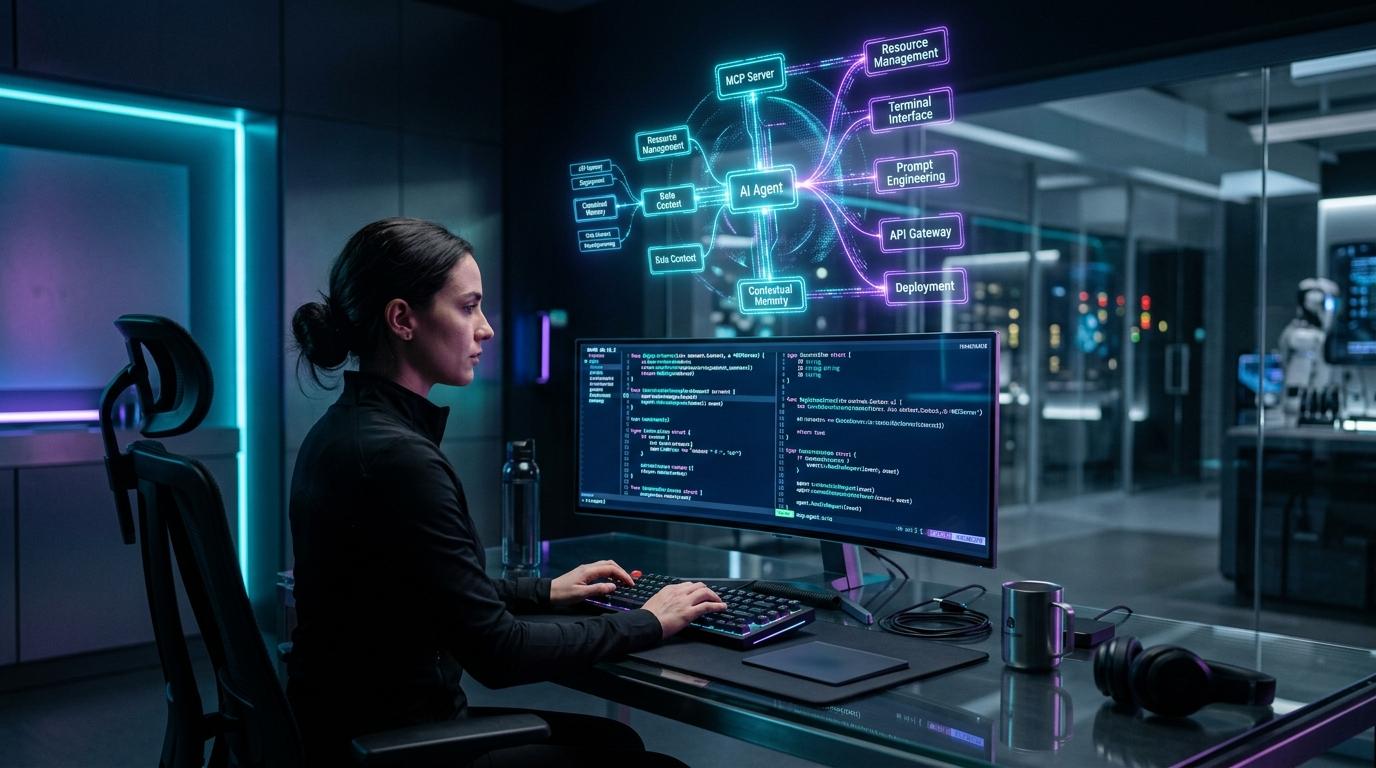
- 1. What Are Autonomous Coding Agents in 2026?
- 2. The Copilot Paradox: Why Inline Autocomplete Hit a Ceiling
- 3. The Model Context Protocol (MCP) Deep Dive
- 4. Autonomous Coding Agents vs. Legacy IDE Assistants Compared
- 5. Production Architecture: Micro-VM Sandboxes, Git Worktrees & Tool-Calling Loops
- 6. Step-by-Step Enterprise MCP Coding Agent Implementation Framework
- 7. Security, Sandboxed Execution & Deterministic Evaluation Harnesses
- 8. Frequently Asked Questions (FAQ)
Critical Architecture Takeaways
- The Paradigm Shift to Systems of Action: In 2026, software development has decisively migrated from inline snippet suggestions (Copilot-era) to closed-loop, terminal-native autonomous coding agents capable of writing code, compiling dependencies, executing unit tests, and self-correcting run-time exceptions.
- Model Context Protocol (MCP) as the Universal Standard: Anthropic's open-source Model Context Protocol has emerged as the universal standard interface connecting foundation reasoning models to local file systems, databases, continuous integration pipelines, and private API tools.
- The Developer as Systems Architect: Human engineers no longer spend 70% of their working hours typing boilerplate syntax. Instead, engineers act as high-level systems architects—framing specifications, establishing strict deterministic test harnesses, and supervising autonomous subagents.
- Micro-VM Sandboxing for Enterprise Security: Modern autonomous coding pipelines run within isolated firewalled micro-VM containers (such as Firecracker or gVisor), preventing untrusted code execution from accessing private corporate networks or exfiltrating credentials.
What Are Autonomous Coding Agents in 2026?
An Autonomous Coding Agent is an intelligent software engineering system that operates with persistent execution loops, utilizing large reasoning models, shell environments, Abstract Syntax Tree (AST) analyzers, and standardized tool protocols (such as MCP) to autonomously diagnose issue tickets, navigate multi-repository codebases, author patch diffs, execute unit tests, and iteratively resolve syntax and logical failures until full verification is achieved.
Throughout 2023 and 2024, artificial intelligence in software engineering was synonymous with inline completion. While useful for generating standalone helper functions or boilerplate algorithms, these early tools operated with severe myopia. They could not observe compiler errors, could not verify whether a database migration functioned, and had no awareness of files outside the active editor window.
By 2026, the software engineering discipline has crossed a monumental threshold: The Transition from Text Generation to Closed-Loop Verification.
Modern autonomous coding agents do not merely guess the next string of characters. Instead, they act as proactive agents operating in full terminal-native developer environments. When assigned an issue ticket, an agent clones the git repository into an isolated ephemeral worktree, searches through hundreds of source files using semantic grep and AST parsing, edits multiple dependencies simultaneously, compiles the project, runs end-to-end integration tests, and reads stderr log traces to iteratively fix its own bugs before submitting a clean pull request.
To understand how high-speed edge hardware accelerates these intelligent models on local developer workstations, explore our architectural analysis on Edge AI Voice Agents & Small Language Models in 2026.
The Copilot Paradox: Why Inline Autocomplete Hit a Ceiling
Between 2022 and 2024, developer productivity metrics encountered a surprising phenomenon known to engineering leadership as The Copilot Paradox.
While developers reported feeling dramatically faster when typing code, overall pull request merge times and software defect rates barely improved. In some large enterprise monorepos, code review backlogs doubled.
The underlying structural causes were three-fold:
- Context Fragmentation: An inline autocomplete model only inspects a few hundred lines above and below the cursor, remaining completely blind to circular dependencies, remote microservice contracts, and database schema migrations.
- The Verification Burden: Developers spent more time carefully reviewing subtly incorrect code snippets than they would have taken to write the code from scratch. Hallucinated APIs and silent edge-case failures slipped into staging environments.
- Inability to Execute: An inline autocomplete model cannot type
npm test, cannot read terminal exit codes, and cannot verify whether a proposed change breaks backwards compatibility across adjacent microservices.
[ Legacy Copilot Architecture (2023-2024) ]
Developer Types Code -> IDE Sends Small Snippet Window -> LLM Guesses Next Tokens -> Developer Must Manually Test & Fix Bugs

[ Autonomous Agentic Architecture (2026) ]
Issue Ticket Assigned -> Agent Creates Ephemeral Git Worktree -> Agent Explores Codebase via MCP ->
Agent Writes Code -> Agent Runs Test Suite in Sandbox -> Reads Stderr -> Self-Heals -> Submits Validated Pull Request
To see how continuous mathematical dynamic systems govern adaptive computation in hardware robotics, read our research report on Liquid Neural Networks (LNNs) in 2026.
The Model Context Protocol (MCP) Deep Dive
Until late 2024, every AI coding assistant relied on fragile, proprietary integration shims. If a developer wanted an agent to query a PostgreSQL database, inspect a Jira backlog, and read local git logs, developers were forced to write bespoke JSON wrapper functions that broke with every major platform update.
In 2026, the Model Context Protocol (MCP) has unified the developer ecosystem.
What is the Model Context Protocol?
MCP is an open-standard, client-server JSON-RPC communication protocol developed to standardize how artificial intelligence reasoning models communicate with external data sources and local tools.
+-------------------------------------------------------------------------+
|                        Autonomous Coding Agent (Host)                   |
|                        (Claude Code / Cursor / CLI)                     |
+------------------------------------+------------------------------------+
                                     |
                                     | (Standardized MCP JSON-RPC 2.0)
                                     v
+-------------------------------------------------------------------------+
|                         Model Context Protocol (MCP) Layer              |
+-------------------+--------------------+-------------------+------------+
                    |                    |                   |
                    v                    v                   v
           [ Local Filesystem ]  [ Postgres Database ] [ GitHub CI API ]
           - Read File           - Execute Query       - Fetch Log
           - Edit Chunk          - Inspect Schema      - Trigger Re-run
           - Grep Symbols        - Explain Plan        - Post PR Review
Core Primitives of the Model Context Protocol
Under the official MCP specification, communication is partitioned into three distinct capabilities:
- Resources: Read-only data payloads that the agent can inspect to establish institutional context (such as repository documentation, schema definitions, and design specifications).
- Tools: Callable deterministic functions with strict JSON schema inputs that allow the agent to execute actions in the external world (e.g., executing a bash command, modifying a file, or querying an API).
- Prompts: Pre-engineered contextual templates that guide multi-step workflows, ensuring the agent adheres to organizational security constraints and code style conventions.
Autonomous Coding Agents vs. Legacy IDE Assistants Compared
Inline IDE Assistants (2023-2024)
Passive autocomplete plugins embedded inside traditional desktop text editors.
- Scope: Single file, active cursor position
- Execution: Passive text generation; cannot run bash commands
- Context: Limited to active buffer and recent tab history
- Feedback Loop: None; relies entirely on manual human verification
- Protocol: Proprietary, fragmented vendor-specific APIs
Autonomous Coding Agents (MCP Native)
Terminal-native and environment-agnostic systems of action with closed-loop verification.
- Scope: Entire monorepos, multi-service dependencies, database schemas
- Execution: Autonomous terminal execution, test running, package installation
- Context: Full codebase indexing via MCP resources and Knowledge Graphs
- Feedback Loop: Self-healing; reads compiler errors and re-tests iteratively
- Protocol: Open-standard Model Context Protocol (MCP) JSON-RPC
Production Architecture: Micro-VM Sandboxes, Git Worktrees & Tool-Calling Loops
Deploying an autonomous agent capable of executing arbitrary bash commands requires defensive systems engineering. Enterprise organizations deploy coding agents within a strict four-layer architecture:
1. Ephemeral Worktree Isolation
When an agent begins a task, it never operates on the developer's working directory. The agent invokes:
git worktree add ../task-agent-sandbox-01 branch-feature-fix
This ensures that active uncommitted developer changes are never overwritten, and multi-agent swarms can simultaneously debug independent branches in parallel.
2. Micro-VM Hardware Sandboxing
To protect corporate infrastructure from unintentional damage or malicious dependencies, tool execution takes place within micro-virtual machines (such as Firecracker or gVisor containers). The sandbox provides:
- Read-only mounting of sensitive system files.
- Network virtualization that blocks access to internal corporate subnets.
- Hardware resource capping (memory, CPU, disk I/O) to prevent infinite compilation loops.
3. The Continuous Evaluation Harness
Before a generated patch is marked as complete, the agent must satisfy an immutable evaluation harness:
$$\text{Verification Score} = \bigwedge_{i=1}^{N} \Big(\text{ExitCode}(\text{Test}_i) == 0\Big) \land \big(\Delta\text{Coverage} \ge 0\big) \land \big(\text{LintErrors} == 0\big)$$
If any test fails, the stderr trace is fed back into the agent's context window, prompting an automated root-cause analysis and surgical code correction.
Step-by-Step Enterprise MCP Coding Agent Implementation Framework
Provisioning Isolated Micro-VM Sandboxes
Configure ephemeral container environments equipped with development toolchains (Node, Python, Go, Rust, Docker) and firewalled network policies that prohibit unauthenticated egress traffic.
Deploying Standardized MCP Servers
Expose internal enterprise data sources—such as git repositories, documentation repositories, and PostgreSQL testing instances—via standardized Model Context Protocol server endpoints.
Configuring Autonomous Agent Tool Loops
Connect the frontier reasoning model to the MCP client. Define deterministic prompt rules enforcing AST linting, unit test validation, and semantic diff generation on every task cycle.
Establishing Human-in-the-Loop Gateways
Route completed agent branches to senior software architects via automated pull requests with visual execution recordings, test logs, and mathematical diff summaries for rapid human signoff.
To understand how executive leadership oversees these automated developer workflows across corporate operations, explore our strategic roadmap on The Fractional AI COO in 2026.
Security, Sandboxed Execution & Deterministic Evaluation Harnesses
The biggest obstacle to enterprise adoption of autonomous coding agents is not intelligence; it is security and governance.
When agents possess terminal access, traditional static code analysis is insufficient. Enterprises enforce three non-negotiable security guardrails:
- Deterministic Prompt Injection Defenses: When agents fetch issues from public issue trackers or review third-party pull requests, text payloads are sanitized to prevent indirect prompt injection attacks designed to exfiltrate environment secrets.
- Read/Write Permission Granularity: MCP servers enforce fine-grained access control. An agent debugging a frontend styling issue is granted write permissions exclusively to CSS and JSX files, while database migration directories remain strictly locked.
- Cryptographic Audit Logs: Every bash command executed, file edited, and network handshake performed by an autonomous agent is permanently recorded in an append-only cryptographic audit log for compliance under SOC2, ISO 27001, and the EU AI Act.
🔒 Deep Dive: Preventing Infinite Agent Loops
In early agent deployments, a failing test would frequently trigger an infinite loop where the agent alternated between two mutually incompatible code fixes, burning thousands of dollars in LLM API tokens. Modern 2026 agent frameworks incorporate dynamic cycle detection algorithms. If an agent produces cyclic diffs or fails to resolve a test within 5 consecutive iterations, the execution freezes, snapshots the workspace, and escalates to a human engineer with an annotated failure report.
Frequently Asked Questions (FAQ)
Will autonomous coding agents replace human software engineers?
No. In 2026, autonomous coding agents replace repetitive syntax typing and manual test execution, not software engineering. The engineer's role evolves into that of a systems architect, specification writer, and safety reviewer. The ability to design distributed systems, balance business trade-offs, and define deterministic evaluation harnesses is more valuable than ever.
How does the Model Context Protocol (MCP) differ from traditional REST APIs?
Traditional REST APIs require developers to build custom integration glue code, handle disparate authentication headers, and write manual parsing logic for every single tool. MCP standardizes tools, resources, and prompt templates under a unified JSON-RPC protocol, allowing any MCP-compliant AI model to discover and invoke tools dynamically at runtime without custom integration code.
Can autonomous coding agents run on local offline hardware?
Yes. With the rapid evolution of quantized Small Language Models (SLMs) and on-device neural processing units (NPUs), developers can run lightweight autonomous coding agents entirely on local workstations without sending proprietary source code to cloud servers. For massive monorepos, hybrid architectures route complex architectural planning to cloud frontier models while running fast test execution and syntax fixes locally.
How do coding agents handle large monorepos with millions of lines of code?
Autonomous agents do not load entire monorepos into their context windows. Instead, they leverage Model Context Protocol servers connected to Abstract Syntax Tree (AST) symbol indexes, semantic vector search, and dependency knowledge graphs. The agent queries specific symbol definitions, interfaces, and call graphs on-demand, consuming minimal context tokens while maintaining total architectural awareness.
- Anthropic. (2026). Model Context Protocol Specification (v2.0): Standardizing Model-Tool Interfaces in Agentic Computing. Open Source Protocols. modelcontextprotocol.io
- IEEE Computer Society. (2026). Closed-Loop Verification in Autonomous Software Engineering Systems. IEEE Transactions on Software Engineering, 52(2), 184–202.
- ACM SIGPLAN. (2026). From Autocomplete to Autonomy: Evaluating Developer Productivity in Agentic Workspaces. Proceedings of the ACM on Programming Languages.
Level Up Your AI & Solo-Founder Strategy
Join 15,000+ founders and engineers getting our field-tested playbooks on autonomous agents, Micro-SaaS architecture, and lean financial frameworks every Thursday.

Specialist in quantum computing, neural networks, and next-generation computational architectures with over 12 years of research and industry consulting experience.
Related Articles
Liquid Neural Networks (LNNs) in 2026: Continuous-Time AI for Autonomous Edge Robotics
Edge AI Voice Agents in 2026: Running Small Language Models (SLMs) On-Device with Sub-100ms Latency
Zero-Knowledge Machine Learning (zkML) in 2026: Cryptographic Proof of Inference, Private Compute & Verifiable AI