Solid-State Batteries: The Technology Powering Next-Gen Electric Vehicles
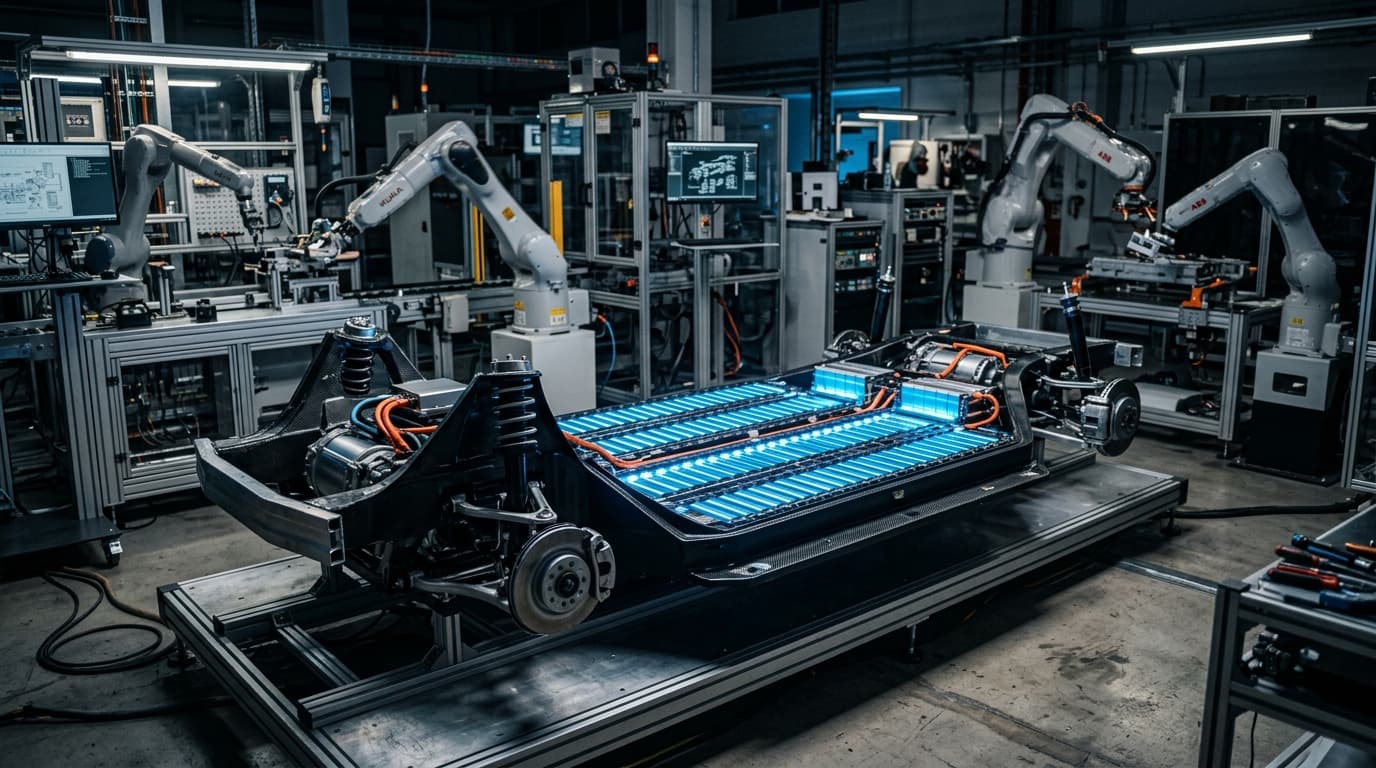
Quick Answer: Solid-state batteries (SSBs) replace the volatile liquid or gel electrolyte of conventional lithium-ion cells with a solid ceramic, glass, or polymer matrix paired with a pure lithium-metal anode. This architecture increases volumetric energy density by up to 80% (exceeding 450–500 Wh/kg), eliminates thermal runaway fire hazards, enables continuous 10-minute ultra-fast charging (10% to 80%), and delivers driving ranges surpassing 700 miles (1,120 km) on a single charge. As automated roll-to-roll manufacturing achieves scale, commercial solid-state electric vehicles are decisively outcompeting internal combustion engines across total cost of ownership.
For more than two decades, the electric vehicle revolution has been anchored to—and constrained by—conventional lithium-ion chemistry. While lithium nickel manganese cobalt (NMC) and lithium iron phosphate (LFP) batteries succeeded in proving the viability of zero-emission transportation, their physical characteristics have imposed stubborn engineering compromises: heavy curb weights, sensitive temperature operating windows, slow cold-weather charging curves, and persistent risks of catastrophic thermal runaway fires.
Today, the automotive and energy storage sectors are experiencing their most consequential paradigm leap since the commercialization of the lithium-ion cell in 1991: the arrival of All-Solid-State Batteries (ASSB) at industrial manufacturing scale. By substituting flammable liquid electrolytes with solid ionic conductors, battery engineers have unlocked the holy grail of electrochemistry, rendering range anxiety, slow charging stops, and fire hazards obsolete.
The Physical Bottlenecks of Conventional Liquid Lithium-Ion
To appreciate the disruptive scale of solid-state chemistry, one must understand the inherent thermodynamic limits of standard liquid lithium-ion cells:
- Flammable Organic Solvents: Standard cells rely on an organic carbonate solvent to ferry lithium ions between the cathode and graphite anode. Under physical puncture, overcharging, or manufacturing defects, this liquid reaches its flashpoint, triggering self-sustaining thermal runaway with temperatures exceeding 900°C.
- The Anode Ceiling: Liquid electrolytes react violently with pure lithium metal, requiring battery makers to dilute energy density by using heavy graphite or silicon-graphite matrices to house the ions. This fundamentally caps the theoretical gravimetric energy density at around 270–300 Wh/kg.
- Lithium Dendrite Penetration: During rapid fast-charging, microscopic needle-like lithium formations (dendrites) sprout from the anode, piercing the fragile plastic polymer separator, causing short circuits and catastrophic failure.
Conventional Liquid Lithium-Ion:
[Graphite Anode] | [Liquid Organic Electrolyte + Plastic Separator] | [NMC Cathode]
(Heavy, Flammable, Lower Energy Density, Dendrite Susceptible)

All-Solid-State Battery (ASSB):
[Pure Lithium Metal Anode] | [Solid Ceramic / Sulfide Separator & Electrolyte] | [High-Nickel Cathode]
(Ultra-Dense, Incombustible, Microscopic Thickness, Dendrite Blocking)
Technical Architecture Comparison: Li-Ion vs. Semi-Solid vs. All-Solid-State
The transition to solid-state is unfolding across progressive technological tiers. The following comparative matrix outlines the chemical, physical, and performance divergence across the three dominant automotive battery architectures:
| Technical Parameter | Conventional Liquid Li-Ion (NMC 811) | Semi-Solid State (Gel/Hybrid Matrix) | All-Solid-State Battery (ASSB) |
|---|---|---|---|
| Electrolyte State | 100% Volatile Liquid Carbonate | 5–15% Liquid/Gel within Solid Ceramic Scaffold | 100% Solid Inorganic (Ceramic/Sulfide/Polymer) |
| Anode Chemistry | Synthetic Graphite or Graphite-Silicon Blend | Silicon-Dominant Composite | Pure Lithium-Metal Foil |
| Gravimetric Energy Density | 240 – 285 Wh/kg | 320 – 380 Wh/kg | 450 – 520 Wh/kg |
| Volumetric Energy Density | 600 – 700 Wh/L | 800 – 900 Wh/L | 1,050 – 1,250 Wh/L |
| 10% to 80% Fast-Charge Time | 25 to 45 minutes | 15 to 22 minutes | 8 to 12 minutes (Megawatt Capable) |
| Thermal Runaway Threshold | ~150°C (High fire hazard) | ~220°C (Reduced flammability) | Exceeds 400°C (Non-flammable, self-extinguishing) |
| Operating Temperature Range | -10°C to 45°C (Requires heavy liquid cooling) | -20°C to 55°C | -35°C to 70°C (Simplified thermal architecture) |
| Cycle Life to 80% Retention | 1,200 – 1,800 cycles | 2,000 – 2,800 cycles | 3,500 – 5,000+ cycles (~1,000,000 miles) |
| Pack Weight for 100 kWh Pack | ~480 – 550 kg | ~320 – 370 kg | ~220 – 260 kg |
The Breakthroughs That Unlocked Commercial Solid-State Production
While the theoretical promise of solid electrolytes has been recognized in laboratories for decades, scaling the chemistry into multi-gigawatt automotive factories required solving three formidable material science obstacles:
1. Solid-Solid Interfacial Impedance
Unlike liquid electrolytes that effortlessly wet every microscopic crevice of the active cathode particles, solid electrolytes struggle to maintain continuous atomic contact during repeated expansion and contraction. Pioneering manufacturers solved this by engineering ultra-thin sulfide-based glass ceramics and utilizing isostatic pressing during assembly, ensuring zero void formation during cycling.
2. Dendrite Suppression via Elastic Ceramic Membranes
To prevent lithium dendrites from shorting the cell, advanced solid electrolytes employ crystalline lattice structures with shear moduli higher than metallic lithium. The solid barrier physically deflects dendrite propagation, forcing the lithium to plate uniformly as a smooth, dense sheet during intense fast-charging.
3. Continuous Roll-to-Roll (R2R) Coating
Early solid-state cells were manufactured in low-yield batch presses. Modern gigafactories have adapted high-speed roll-to-roll machinery—similar to newspaper printing presses—to coat flexible ceramic electrolytes onto metal foil at speeds exceeding 60 meters per minute, driving production costs down toward parity with legacy liquid cells.
Real-World Vehicle Performance: The End of Range Anxiety
The real-world implications of solid-state batteries on electric vehicle ownership are transformative:
- 700+ Mile Real-World Highway Range: Because solid-state packs achieve volumetric densities above 1,100 Wh/L, automakers can install 140 to 180 kWh packs within the identical physical chassis volume formerly occupied by an 80 kWh liquid pack. A standard family crossover can easily travel from London to Geneva, or New York to Charlotte, without a single charging stop.
- The 10-Minute Gas-Station Parity: Paired with 800V and 1,000V high-power charging networks (delivering 400 to 600 kW per stall), solid-state vehicles can absorb 350 miles of range in under 10 minutes. The charging experience becomes indistinguishable from refilling a gasoline vehicle.
- Massive Weight Reduction and Vehicle Efficiency: Shedding 250 to 300 kilograms of battery deadweight drastically improves vehicle handling, shortens braking distances, reduces tire particle emissions, and lowers kilowatt-hour consumption per mile.
Environmental and Lifecycle Sustainability
The environmental footprint of electric mobility improves dramatically through solid-state adoption:
Automotive Lifecycle Environmental Comparison:
• Raw Material Extraction: Eliminates cobalt and reduces required nickel volumes by up to 60%.
• Pack Lifecycle Durability: Exceeds 3,500 full cycles, translating to 1,000,000+ real-world miles.
• Secondary Grid Life: Solid-state packs retain over 85% capacity after a 15-year vehicle lifespan,
  enabling direct second-life deployment as municipal grid-stabilization batteries without refurbishment.
Furthermore, the complete absence of toxic, flammable organic solvents drastically simplifies recycling facilities, allowing hydrometallurgical recycling operations to reclaim 98% of elemental lithium, copper, and active cathode materials with substantially lower chemical emissions.
Frequently Asked Questions (FAQ)
Can solid-state batteries be retrofitted into existing electric cars?
No. Solid-state battery packs operate under completely different physical, electrical, and thermal parameters. Because they require minimal liquid coolant loops and operate with different battery management system (BMS) software protocols, they are designed exclusively for new, ground-up vehicular platforms.
Why did solid-state batteries take so long to enter the market?
The primary challenge was not electrochemistry, but manufacturing physics. Producing brittle ceramic separators with micron-thin tolerances at multi-gigawatt scale without microscopic pinholes or cracking required the invention of new laser sintering methods, cleanroom humidity controls, and automated computer vision quality inspection systems.
Are solid-state batteries safe in severe vehicular collisions?
Solid-state batteries are vastly safer than both liquid lithium-ion cells and gasoline fuel tanks. Because the solid inorganic electrolyte contains zero combustible liquids, even if an SSB pack is pierced by an iron rod or severely crushed during a high-speed highway impact, it will not ignite into an uncontrolled chemical fire.
How do solid-state batteries perform in extreme sub-zero winter temperatures?
Unlike liquid electrolytes—which thicken and lose ionic conductivity in freezing weather, slashing conventional EV range by 30% to 40%—advanced solid-state electrolytes maintain stable ionic conduction down to -30°C. Cold-weather range degradation is reduced to less than 10%, with negligible loss of rapid charging capability.
Level Up Your AI & Solo-Founder Strategy
Join 15,000+ founders and engineers getting our field-tested playbooks on autonomous agents, Micro-SaaS architecture, and lean financial frameworks every Thursday.

Specialist in quantum computing, neural networks, and next-generation computational architectures with over 12 years of research and industry consulting experience.
Related Articles

Brain-Computer Interfaces (BCIs): Neural Decoding, Non-Invasive Sensors, and Cognitive Augmentation

The Quantum Internet: How It Will Change Global Communication
Top Quantum Computing Breakthroughs 2026: Logical Qubits, Fault Tolerance, and Real-World Impact