Circadian Sleep Architecture: The Clinical Protocol for Deep Restorative Sleep
In the contemporary health dialogue, the conversation surrounding sleep has become fixated on a single, simplistic metric: total time spent in bed. Digital fitness trackers celebrate eight hours of horizontal rest, yet millions of high-performing knowledge workers wake up chronically fatigued, cognitively foggy, and reliant on stimulant cycling simply to reach baseline alertness.
This discrepancy stems from a fundamental misunderstanding of human neurobiology: sleep quantity is merely the container; sleep architecture is the actual medicine.
During an optimal night of rest, the human brain and central nervous system undergo a tightly choreographed physiological sequence. Cerebrospinal fluid surges through brain parenchyma to wash away toxic metabolic byproducts, pituitary growth hormone repairs cellular micro-damage, and hippocampal neural circuits transfer short-term sensory experiences into permanent cortical memory networks.
When circadian timing, thermal regulation, or autonomic tone are misaligned, this intricate architecture collapses. You can spend eight or even nine hours in bed, but if your physiology fails to transition into sustained Slow-Wave Sleep (Stage 3 NREM) and consolidated Rapid Eye Movement (REM) phases, your cellular rejuvenation remains stunted.
This clinical protocol unpacks the biological mechanisms governing sleep architecture and provides a step-by-step physiological routine to achieve deep, restorative sleep night after night.
The Neurobiology of Sleep Architecture
Human nocturnal rest is organized into 90- to 110-minute ultradian cycles, repeating four to six times per night. Each cycle transitions through distinct neurochemical and electroencephalographic (EEG) states:
[ Wakefulness / High Beta Waves ]
              │
              ▼
[ Stage 1 NREM: Alpha-to-Theta Transition (Light Drowse) ]
              │
              ▼
[ Stage 2 NREM: Sleep Spindles & K-Complexes (Sensory Gating) ]
              │
              ▼
[ Stage 3 NREM: Slow-Wave Sleep / Delta Waves (Physical Restoration) ]
              │
              ▼
[ REM Sleep: High Desynchronized Waves (Emotional & Memory Consolidation) ]
1. Slow-Wave Sleep (Stage 3 NREM)
Slow-Wave Sleep (SWS), characterized by high-amplitude, low-frequency delta oscillations (0.5 to 4 Hz), dominates the first third of the nocturnal cycle. During this phase:
- Glymphatic Waste Clearance: Glial cells shrink by up to 60%, allowing interstitial channels to expand and cerebrospinal fluid (CSF) to flush out neurotoxic proteins, including beta-amyloid and hyperphosphorylated tau.
- Endocrine Resurgence: The anterior pituitary releases up to 70% of the body's daily pulsatile Human Growth Hormone (HGH), facilitating muscle protein synthesis, systemic tissue repair, and immune system rejuvenation.
- Cardiovascular Rest: Sympathetic outflow drops to near zero, heart rate drops to its resting baseline, and arterial blood pressure declines by 10% to 20% (known clinically as nocturnal dipping).
2. Rapid Eye Movement (REM) Sleep
REM sleep dominates the final third of the night. During REM:
- The brain exhibits vivid dream states with neural activity resembling wakefulness, yet motor neurons in the spinal cord are actively inhibited (skeletal muscle atonia).
- The brain strips emotional charge from waking traumatic experiences through noradrenergic silence.
- Neuroplastic consolidation integrates newly learned cognitive skills into existing associative neural networks.
Comparison: Basic Sleep Hygiene vs. Clinical Sleep Architecture
Most generic sleep advice stops at basic hygiene (e.g., "avoid screens before bed"). Clinical sleep architecture addresses the underlying autonomic, endocrine, and thermal drivers of neurological recovery:
| Parameter | Standard Sleep Hygiene Advice | Clinical Sleep Architecture Protocol | Physiological Mechanism |
|---|---|---|---|
| Morning Routine | Wake up at a consistent hour | View 10,000+ lux natural photons within 30 min | Sets Suprachiasmatic Nucleus (SCN) circadian timer; initiates cortisol peak |
| Light Environment | Turn down bedroom lamps | Complete spectrum blue/green depletion below 2 lux | Triggers pineal melatonin synthesis without pharmacological dependence |
| Thermal Regulation | Keep the room reasonably cool | Ambient 65°F (18°C) + distal vasodilation protocol | Facilitates 1°C core body temperature drop required for delta wave entry |
| Caffeine Management | Stop coffee after dinner | Cease adenosine antagonism 9 to 10 hours pre-sleep | Clears competitive adenosine receptor block before homeostatic sleep pressure peak |
| Evening Nutrition | Do not eat heavy meals | Complete caloric intake 3 hours pre-sleep; low glycemic | Prevents insulin surges, nocturnal hypoglycemia, and nocturnal heart rate elevation |
| Sleep Biomechanics | Use any comfortable pillow | Lateral side sleeping with cervical and pelvic alignment | Maximizes glymphatic drainage pathways and eliminates micro-arousal airway resistance |
The Four Biological Levers of Sleep Architecture
To reliably induce deep restorative sleep, your evening environment must synchronize four biological levers:
1. The Circadian Zeitgeber (Light & Melatonin)
The master circadian clock located in the brain's Suprachiasmatic Nucleus (SCN) takes its primary synchronization cues from environmental photons hitting intrinsically photosensitive Retinal Ganglion Cells (ipRGCs).
- Morning Anchor: Exposure to natural sunlight (or a 10,000 lux seasonal lamp) within thirty minutes of waking triggers a healthy cortisol pulse and sets an internal timer for pineal melatonin release approximately 14 to 16 hours later.
- Evening Shield: After sunset, exposure to blue wavelengths (460 to 480 nm) suppresses melatonin secretion by up to 85%. Switching to warm amber lighting (below 2700 Kelvin) preserves natural melatonin cascades.
2. The Thermal Nadir (Core Body Temperature)
To initiate Slow-Wave Sleep, the human body must lower its internal core temperature by approximately 1°C (2°F).
- The Warm Bath Paradox: Taking a warm shower or bath 90 minutes before bed causes vasodilation (blood vessels in the hands and feet dilate), rapidly radiating heat out of the core and causing internal core temperature to plummet, accelerating sleep onset latency by up to 36%.
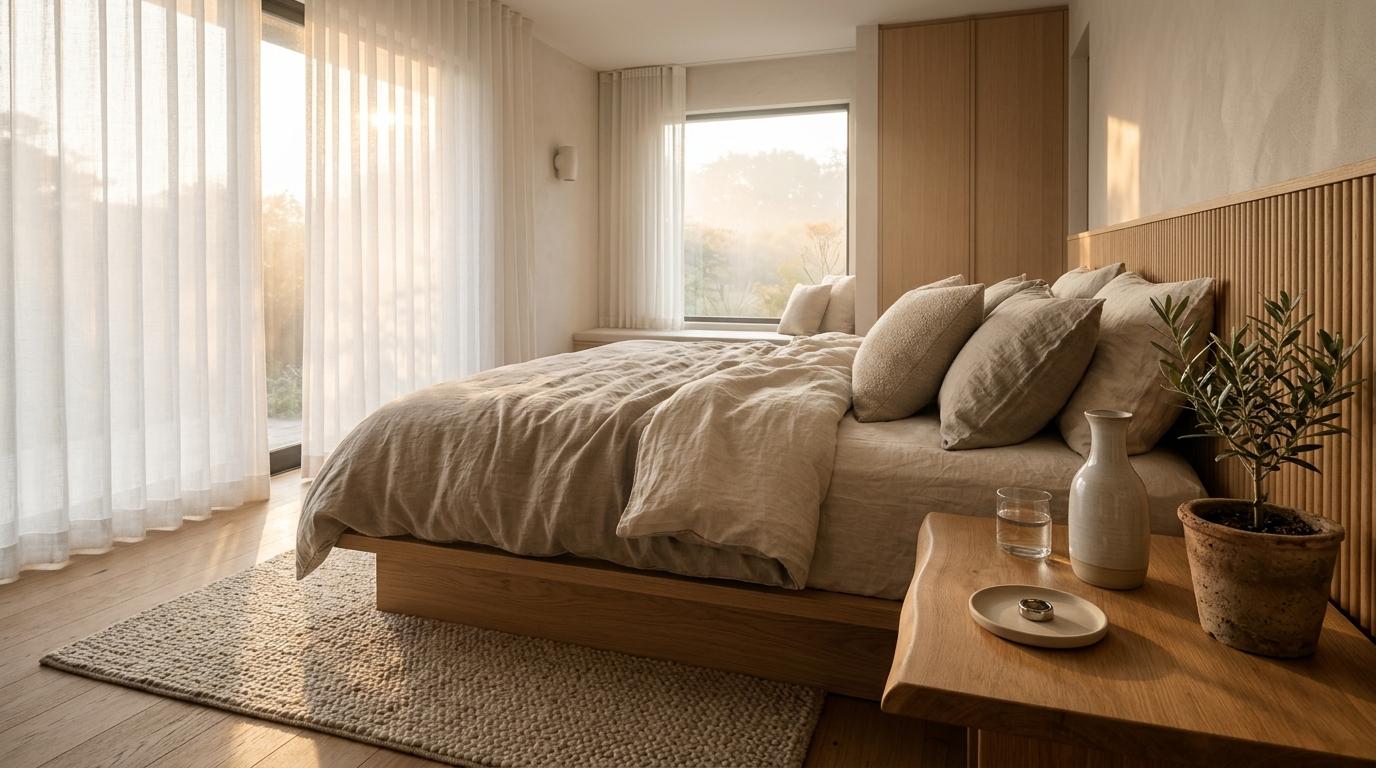
- Ambient Setting: Maintain bedroom ambient temperature between 64°F and 67°F (17°C to 19°C) with breathable natural fiber bedding (such as organic linen or bamboo).
3. Homeostatic Adenosine Pressure
Adenosine accumulates in the brain throughout every waking second as a byproduct of cellular ATP consumption. As adenosine binds to its receptors in the basal forebrain, it builds irresistible "sleep pressure."
- Caffeine Pharmacokinetics: Caffeine is a competitive adenosine antagonist with an average half-life of 5 to 7 hours and a quarter-life of up to 12 hours. Drinking caffeine at 3:00 PM means 25% of that stimulant remains active in your cerebral receptors at 3:00 AM, fracturing slow-wave delta transitions.
4. Sleep Ergonomics and Glymphatic Biomechanics
Neuroimaging studies reveal that lateral sleeping (side sleeping) provides significantly superior glymphatic CSF transport compared to prone (stomach) or supine (back) positions.
- Keep the cervical spine neutral with a supportive contoured pillow to prevent airway collapse and micro-apneas.
- Place a thin contoured knee pillow between the legs to maintain pelvic alignment and eliminate lumbar nerve compression.
The Clinical Evening Protocol: Step-by-Step
Implement this four-phase operational sequence every evening to ensure maximum slow-wave and REM consolidation:
[ T-minus 180 Minutes (Evening Nutrition) ]
  └── Finish last caloric meal; maintain stable glycemic levels.
  └── Hydrate with mineral-rich water; cease high-volume fluid intake.

[ T-minus 90 Minutes (Thermal & Autonomic Down-Shift) ]
  └── Warm shower or bath (104°F / 40°C) for 15 minutes to trigger vasodilation.
  └── Dim all overhead fixtures; transition home lighting to warm amber.

[ T-minus 45 Minutes (Neural Deceleration) ]
  └── Eliminate high-friction screens, work email, and intense social media feeds.
  └── Practice 10 minutes of physiological sighing or breathwork.

[ Bedtime (Sensory Deprivation) ]
  └── Room completely blacked out (100% blackout blinds or contoured eye mask).
  └── Ambient temperature set to 66°F (18.5°C); device notifications silenced.
For readers looking to deepen their neuro-somatic recovery and autonomic balancing, integrating daytime restorative practices—such as our clinical guide on Non-Sleep Deep Rest (NSDR) and Autonomic Regulation—provides the nervous system with structured parasympathetic resets that dramatically accelerate nocturnal sleep onset.
Furthermore, monitoring baseline physiological biomarkers through tools like Continuous Glucose Monitoring and understanding foundational principles from Biohacking for Beginners allows individuals to tailor their sleep architecture to their exact metabolic genetics.
Frequently Asked Questions
How much Slow-Wave Sleep (Deep Sleep) should an adult get each night?
In healthy adults, Slow-Wave Sleep (Stage 3 NREM) should comprise approximately 15% to 25% of total nocturnal sleep duration, translating to roughly 70 to 110 minutes per night. REM sleep should comprise an additional 20% to 25% (90 to 120 minutes). If your wearable tracker routinely reports under 45 minutes of deep sleep despite 8 hours in bed, thermal or circadian disruption is almost always the cause.
Can supplemental melatonin fix disrupted sleep architecture?
Over-the-counter melatonin is frequently overused at supra-physiological doses (3 mg to 10 mg), which can desensitize brain melatonin receptors and cause vivid nightmares or morning grogginess. Physiologically, the body produces less than 0.3 mg per night. Optimizing environmental lux exposure, thermal down-regulation, and evening wind-down routines is vastly superior to chronic exogenous supplementation.
Is side sleeping strictly necessary for brain recovery?
While back sleeping is acceptable for individuals with zero airway resistance, clinical studies demonstrate that lateral side sleeping enhances glymphatic waste clearance by more than 25% compared to supine sleeping. It also dramatically reduces snoring and mild positional obstructive hypopneas that disrupt sleep staging.
Level Up Your AI & Solo-Founder Strategy
Join 15,000+ founders and engineers getting our field-tested playbooks on autonomous agents, Micro-SaaS architecture, and lean financial frameworks every Thursday.

Clinical researcher and physician specializing in continuous metabolic biosensors, circadian medicine, neuroplasticity biohacking, and evidence-based longevity.
Related Articles
Non-Sleep Deep Rest and Autonomic Regulation: A Clinician's Protocol for Cognitive Recovery

Non-Invasive Continuous Blood Glucose Monitoring for Non-Diabetics in 2026: A Practical Guide to Energy and Longevity

Cell-Free DNA (cfDNA) Liquid Biopsies and Circadian Methylation Rhythms in 2026: The Rise of Home Cancer Interception Protocols