Next-Gen Smart Home Security: AI Guardians and Autonomous Defense
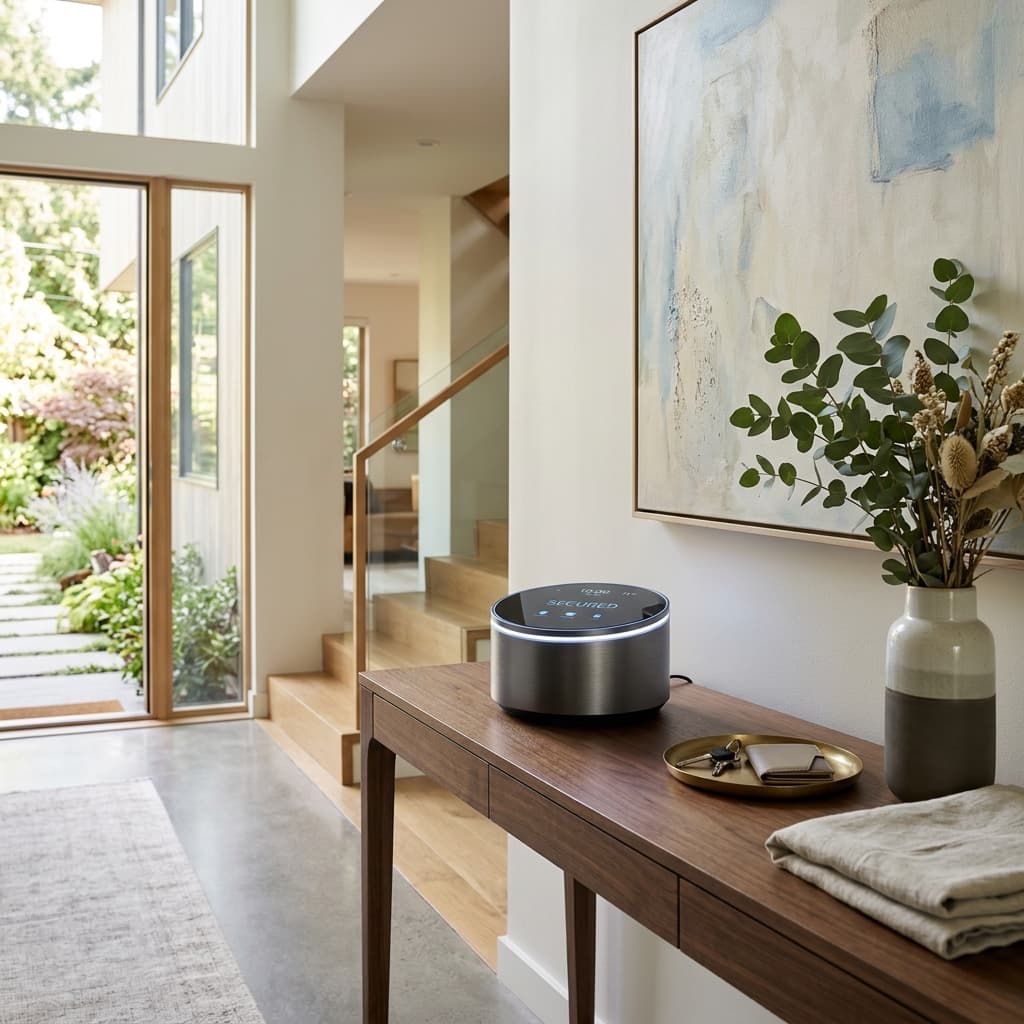
Quick Answer: Next-generation smart home security systems have transitioned from passive, reactive alarms to autonomous Predictive AI Guardians. Operating on local edge neural processors rather than vulnerable cloud servers, these systems utilize multi-sensor fusion—combining privacy-preserving millimeter-wave (mmWave) radar, biometric gait recognition, and acoustic micro-vibration telemetry—to anticipate and preemptively deter security breaches before physical intrusion occurs, reducing false alarm rates by over 98% while preserving household privacy.
For decades, the residential security industry relied on technology fundamentally unchanged since the late 1970s: a constellation of magnetic door reed switches, infrared motion detectors (PIR) triggered by wandering house pets, and loud 110-decibel sirens that blared only after an intruder shattered a ground-floor window. When homeowners transitioned to early consumer smart cameras, the experience frequently proved frustrating: hundreds of false push notifications triggered by blowing tree branches, passing delivery trucks, or neighborhood cats, combined with severe privacy vulnerabilities exposed by cloud-based camera data leaks.
Today, modern residential protection is undergoing an architectural revolution: the emergence of the Autonomous AI Home Guardian. Driven by dedicated on-premises edge computing, sensor fusion, and predictive artificial intelligence, modern properties no longer merely record crime; they actively anticipate perimeter threats, execute non-lethal proactive deterrence protocols, and protect residential privacy without streaming domestic video feeds into corporate cloud servers.
The Paradigm Shift: From Reactive Sirens to Predictive Edge Deterrence
The fatal flaw of conventional residential security is that it is entirely reactive: alarms engage after the structural envelope has already been breached, leaving homeowners vulnerable to fast smash-and-grab intrusions before municipal law enforcement can dispatch emergency responders (which averages 12 to 25 minutes in suburban jurisdictions).
Next-generation AI guardians invert this timeline through predictive multi-stage perimeter containment:
Legacy Reactive Security Sequence:
[Intruder Smashes Window] ──► [Siren Sounds] ──► [Call Center Dials Owner] ──► [Police Dispatched (18 min)] ──► [Intruder Escaped]

Predictive AI Guardian Sequence:
[Approach Detected at 30ft] ──► [Gait Analysis Flags Stranger] ──► [Targeted Dynamic Spotlight]
                                                                              │
                                                                              ▼
[Active Occupancy Simulation] ◄── [Perimeter Micro-Drone Scans] ◄── [Acoustic Warning: "You Are Being Monitored"]
                                                                              │
                                                                              ▼
                                                    [Threat Dissuaded: Zero Physical Damage / 0 Second Delay]
Architectural Comparison: Traditional Alarms vs. Cloud Cams vs. Edge AI Guardians
To understand the profound operational divergence between outdated monitored alarms and modern autonomous security architectures, examine this comprehensive comparative matrix:
| Security Dimension | Traditional Monitored Alarm (e.g., ADT) | Cloud-Connected Smart Cam (e.g., Ring/Nest) | Autonomous Edge AI Guardian System |
|---|---|---|---|
| Detection Methodology | Binary door contact pins & passive PIR heat | Optical pixel motion detection via cloud AI | Multimodal Edge Sensor Fusion (mmWave + LiDAR + Vision) |
| False Alarm Rate | Extremely High (Over 90% of calls are false) | High (Wind, shadows, pets trigger alerts) | Near Zero (< 1.5% through cross-sensor verification) |
| Compute Architecture | Analog dialer / basic cellular 2G/3G modem | Remote public cloud servers (AWS/Azure) | Local On-Premises Neural Processing Unit (NPU) |
| Latency to Threat Deterrence | 30 to 90 seconds (Monitoring station verification) | 5 to 15 seconds (Cloud roundtrip latency) | < 200 milliseconds (Instant local execution) |
| Privacy & Video Eavesdropping | No video, but pinpad access codes vulnerable | High risk; video stored on third-party cloud servers | Absolute; zero raw domestic video ever leaves the local network |
| Internet Outage Resilience | Cellular backup only for basic alarm signal | System fails; cameras cannot stream or record | 100% fully operational offline via local battery & edge AI |
| Deterrence Capability | Passive loud siren after physical entry | Push alert to phone; manual two-way talk | Automated dynamic deterrence (Drone, lighting, acoustics) |
| Recurring Monthly Cost | $45 – $70 / month mandatory contracts | $10 – $25 / month cloud storage subscriptions | $0 / month (Fully self-hosted, sovereign architecture) |
The 4 Foundational Pillars of Modern AI Residential Defense
A robust next-generation security perimeter integrates four sophisticated technological layers operating in unison:
1. Privacy-Preserving mmWave Radar & Sub-Terahertz Sensing
Instead of installing intrusive indoor optical cameras in bedrooms and living rooms, high-tier properties utilize millimeter-wave (mmWave) radar sensors. These unobtrusive sensors emit high-frequency radio waves that penetrate walls, furniture, and darkness to generate real-time spatial point clouds.
- Biometric Presence & Respiration: mmWave sensors detect the microscopic chest movements of a breathing human, differentiating between an inanimate object, a 40-pound dog, and a concealed human intruder hiding behind curtains—without capturing a single identifiable visual pixel.
- Fall Detection and Elder Care: The same radar arrays instantly detect sudden domestic medical emergencies (such as slip-and-fall incidents), dispatching automated emergency notifications without invading personal dignity.
2. Biometric Gait Recognition and Continuous Facial Telemetry
Traditional keypads and mechanical locks can be picked, duplicated, or brute-forced. Autonomous access systems utilize computer vision models trained on human gait biomechanics.
- As you walk toward your entryway, outdoor stereo-depth cameras evaluate your distinctive skeletal stride, arm swing cadence, height, and facial geometry.
- The deadbolt disengages frictionlessly before your hand touches the handle, while unauthorized individuals attempting to follow closely behind are instantly locked out.
3. Edge-Computing Local NVRs & Zero-Cloud Telemetry
To safeguard household privacy from corporate surveillance and data breaches, modern installations deploy Local Edge Network Video Recorders (NVRs) powered by dedicated 30+ TOPS neural processing chips.
- Facial recognition, license plate reading, and object classification algorithms execute entirely within a hardened on-premises server inside the home.
- The system communicates across open, encrypted local protocols (such as Matter over Thread and Home Assistant), operating with zero dependency on external cloud providers.
4. Autonomous Rooftop Micro-Drones
For expansive suburban properties, acreages, and private estates, stationary cameras leave inevitable visual blind spots behind outbuildings, dense foliage, and fences.
- Weather-sealed rooftop docking stations house autonomous micro-drones equipped with thermal infrared forward-looking sensors (FLIR) and low-noise propeller shrouds.
- Upon an unverified perimeter trigger, the drone launches autonomously, flies to the GPS waypoint within 15 seconds, shines a focused tracking spotlight on the intruder, transmits high-definition thermal telemetry to the homeowner’s dashboard, and returns to its dock to recharge.
5-Step Security Hardening Blueprint for Modern Homeowners
For property owners seeking to transition from legacy alarm hardware to an autonomous edge guardian architecture, follow this verified implementation roadmap:
Step 1: Network Isolation (VLAN Hardening)
  └── Isolate all IoT security devices, IP cameras, and smart locks onto a dedicated, non-routable VLAN.

Step 2: Deploy Edge Neural Hardware
  └── Install a local NVR or edge micro-server running local open-source vision models (e.g., Frigate NVR + Coral TPU).

Step 3: Replace PIR with mmWave Radar
  └── Swap outdated infrared motion detectors for multi-zone mmWave radar sensors in ground-floor corridors.

Step 4: Establish Automated Proactive Deterrence
  └── Script smart lighting and directional outdoor speakers to execute progressive occupancy simulation upon perimeter approach.

Step 5: Install Hardened Failsafes
  └── Equip the central security cabinet with an uninterruptible power supply (UPS) and encrypted local LTE/satellite failover.
Frequently Asked Questions (FAQ)
What happens to an autonomous smart home security system during a power or internet outage?
A properly engineered edge-security architecture is completely self-contained. The local neural processing server, PoE cameras, and mmWave sensors are powered by dedicated lithium iron phosphate (LiFePO4) uninterruptible battery backups (UPS) that sustain full operations for 48 to 72 hours. Because AI inference occurs locally on-device, detection and deterrence protocols operate with zero degradation even if the fiber internet connection is completely severed.
How does the AI guardian distinguish between a prowler and an outdoor pet or wild animal?
Through multi-sensor temporal tracking. Traditional motion sensors merely register moving heat signatures. Autonomous edge AI analyzes the volumetric mass, skeletal joint kinematics, and movement trajectories of the target. A wandering deer, wandering raccoon, or domestic dog moves with distinct quadrupedal mechanics and low ground clearance that the neural network discards instantly, completely eliminating false sirens.
Can an edge-based smart home security system be hacked from the internet?
By removing third-party public cloud servers and port-forwarding from the architectural loop, the attack surface is diminished by over 99%. Systems operating within isolated Virtual Local Area Networks (VLANs) with zero external internet ingress cannot be accessed by external web crawlers. Remote homeowner access is achieved exclusively through encrypted, self-hosted VPN tunnels (such as WireGuard or Tailscale).
Are indoor cameras strictly necessary for complete home protection?
No. High-security modern installations avoid indoor RGB cameras entirely. By pairing exterior perimeter optical cameras with indoor privacy-safe mmWave radar arrays and acoustic glass-break vibration sensors, the property achieves impenetrable spatial awareness and intrusion tracking while guaranteeing that family members enjoy complete, unmonitored visual privacy within their living spaces.
Level Up Your AI & Solo-Founder Strategy
Join 15,000+ founders and engineers getting our field-tested playbooks on autonomous agents, Micro-SaaS architecture, and lean financial frameworks every Thursday.

Specialist in quantum computing, neural networks, and next-generation computational architectures with over 12 years of research and industry consulting experience.
Related Articles

Top 5 Upcoming Tech Gadgets That Will Change How You Live

The Road to AGI: What Artificial General Intelligence Means for Humanity

Solid-State Batteries: The Technology Powering Next-Gen Electric Vehicles