Decentralized AI Compute Clusters and Tokenized GPU Capital Markets in 2026: The New Treasury Standard for Autonomous Enterprises
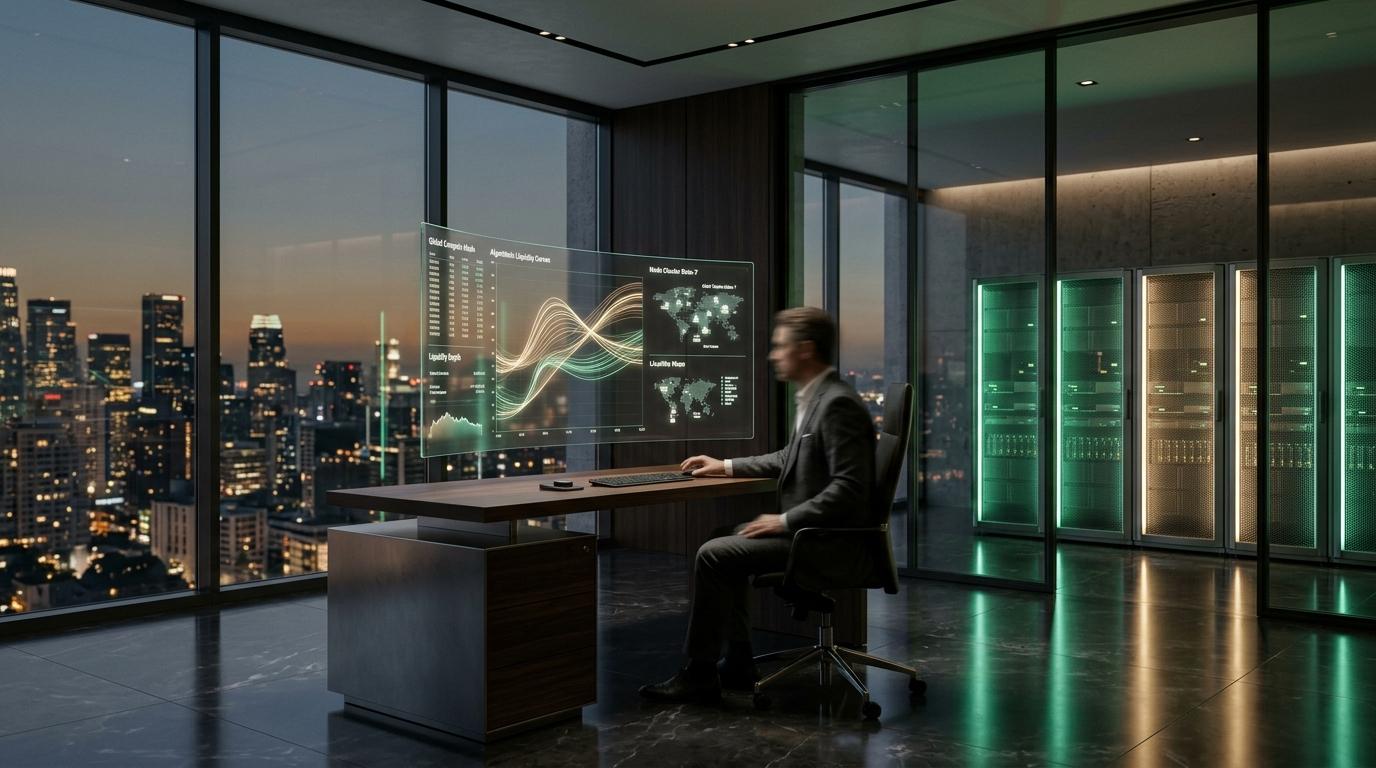
1. The Macro Problem: The Hyperscaler Oligopoly and Compute Hyper-Volatility
Throughout the initial expansion phase of generative AI (2022–2024), enterprises faced a financial conundrum. Training and serving frontier foundation models required thousands of top-tier AI accelerators (such as NVIDIA H100 and B200 systems).
This reliance created three structural financial risks for corporations:
- Predatory Multi-Year Vendor Lock-In: Legacy hyperscalers (Amazon AWS, Microsoft Azure, Google Cloud) forced enterprise customers to sign inflexible 3-to-5 year reserved instance contracts with steep prepayment penalties.
- Extreme Price Volatility: Whenever a frontier model dropped, spot inference prices surged by up to 400% overnight as global demand saturated cloud regions.
- Balance Sheet Inefficiency: Cash held in traditional money market funds or sovereign bonds yielded 3% to 4%, while the enterprise's primary operating cost—compute capacity—was inflating at an annualized rate of 42%.
In 2026, the corporate treasury paradigm has fundamentally shifted. The emergence of Tokenized GPU Capital Markets and Decentralized Physical Infrastructure Networks (DePIN) has transformed GPU capacity from an illiquid service into a standardized financial commodity, comparable to crude oil, electricity futures, or gold reserves.
+-----------------------------------------------------------------------------------+
|               ENTERPRISE COMPUTE SOURCING EVOLUTION (2022 vs 2026)                |
+-----------------------------------------------------------------------------------+
| Metric / Feature      | 2022 Cloud Hyperscalers      | 2026 DePIN GPU Capital Mkts|
+-----------------------+------------------------------+----------------------------+
| Procurement Cycle     | 3-6 month RFP & legal reviews| Sub-second automated smart |
| Contract Flexibility  | 3-year rigid take-or-pay     | Continuous streaming micro |
| Pricing Transparency  | Opaque negotiated enterprise | Real-time global spot & DEX|
| Liquidity & Resale    | 0% (Forbidden by cloud TOS)  | 100% liquid secondary sale |
| Treasury Utilization  | Pure sunk OpEx loss          | Yield-bearing balance asset|
+-----------------------------------------------------------------------------------+
2. Market Mechanics: How Tokenized GPU Derivatives Work
Standardizing heterogeneous compute hardware across the globe required rigorous financial and cryptographic engineering. A server rack in Frankfurt housing liquid-cooled GB200 systems has different latency, interconnect bandwidth, and memory specs compared to an enterprise cluster in Tokyo or a solar-powered facility in Texas.
In 2026, decentralized compute clearinghouses resolved this problem by establishing the Normalized Compute Unit (NCU) standard:
$$1\text{ NCU} = 10^{18}\text{ FLOPs at FP8 Precision with minimum } 900\text{ GB/s Interconnect Bandwidth}$$
Synthetic Compute Hedging
Enterprises lock in compute supply 6 to 18 months ahead of major model fine-tuning releases. If spot inference prices spike, the value of their long futures contracts offsets operating cost spikes.
Secondary Compute Liquidity
Enterprises that find themselves with surplus reserved GPU capacity do not let silicon sit idle. They instantly route unutilized nodes to decentralized decentralized physical infrastructure pools, earning real-time yield in stablecoins.
Zero-Knowledge Proof of Work
Using ZK-STARK attestation circuits, the client's orchestrator verifies mathematically that weights were accurately processed and matrix calculations were executed without tampering or eavesdropping.
Per-Token Settlement Channels
Eliminating monthly invoicing, payments settle dynamically per million tokens generated via sub-second payment channels on high-throughput Layer-1 and Layer-2 blockchains.
The Compute Treasury Standard (CTS)
In 2026, progressive corporate treasuries manage a diversified Compute Reserve Portfolio:
- Physical DePIN Capacity (40%): Direct cryptographic control of dedicated bare-metal GPU clusters distributed across non-hyperscaler tier-3 data centers worldwide.
- Liquid Compute Tokens (35%): Highly liquid tokens directly redeemable for GPU execution hours across multi-provider decentralized networks (e.g., Render, Akash, io.net, and Gensyn derivatives).
- Synthetic Compute Hedges (25%): Options and perpetual futures contracts designed to capture upside in compute demand or insure against sudden regional power grid failures.
3. Financial Case Study: The 2026 Autonomous Fintech Enterprise
To quantify the financial advantage of decentralized compute treasury strategies, consider a comparative financial audit of Aetheris Capital, an autonomous algorithmic trading and advisory enterprise with an annualized compute workload of 45 million inference tokens per minute:
+--------------------------------------------------------------------------------------+
|                     AETHERIS CAPITAL: 12-MONTH COMPUTE AUDIT                         |
+--------------------------------------------------------------------------------------+
|                                                                                      |
|   Traditional Cloud Hyperscaler Allocation:                                          |
|   - Multi-year reserved instance commitment:         $14,200,000                     |
|   - Peak burst on-demand cloud surge charges:        $ 3,850,000                     |
|   - Unutilized off-peak capacity waste:             -$ 2,400,000 (Idle cost)         |
|   --------------------------------------------------------------                     |
|   Total Net Annual Compute Cost:                     $18,050,000                     |
|                                                                                      |
|   2026 Decentralized DePIN & Compute Treasury Model:                                 |
|   - Base DePIN cluster aggregation (multi-region):   $ 7,150,000                     |
|   - Real-time spot load balancing via smart routing: $ 1,220,000                     |
|   - Secondary market sublease of idle off-peak GPU: -$ 1,940,000 (Revenue earned)    |
|   - Treasury compute futures hedging profit:        -$   880,000 (Hedge gain)        |
|   --------------------------------------------------------------                     |
|   Total Net Annual Compute Cost:                     $ 5,550,000                     |
|                                                                                      |
|   >>> NET CAPITAL SAVINGS:                           $12,500,000 (69.2% Cost Cut)    |
|                                                                                      |
+--------------------------------------------------------------------------------------+
By decoupling their infrastructure from monolithic cloud vendors and managing compute as an active financial balance sheet asset, the enterprise reduced net operating expenses by 69.2% while simultaneously achieving higher multi-region fault tolerance.
4. Key Performance Benchmarks in 2026 DePIN Markets
5. Risk Management Framework for Corporate Treasurers
Deploying enterprise balance sheet reserves into tokenized physical infrastructure networks requires a sophisticated corporate governance and risk management architecture:
1. Counterparty & Node Slashing Guarantees
Unlike unregulated decentralized protocols of the past, 2026 institutional DePIN networks utilize staking escrows and programmatic node slashing. If an independent data center experiences unexpected downtime, packet loss, or hardware failure during mission-critical inference jobs, its staked cryptographic collateral is automatically liquidated to refund the enterprise and reroute tasks to a warm failover node within milliseconds.
2. Data Sovereignty and Zero-Knowledge Confidentiality
A primary concern for institutional CFOs and General Counsels is preventing trade secret leaks when running proprietary enterprise models on decentralized clusters. 2026 architectures mandate hardware-level Confidential Computing (AMD SEV-SNP, Intel TDX, and NVIDIA H100/B200 Trusted Execution Environments). Model weights and inference data remain encrypted in memory, preventing node operators from intercepting or reconstructing enterprise prompts.
3. Regulatory Compliance: Basel IV & SOC-2 Type III Auditing
Tokenized compute instruments are classified under forward commodity trading frameworks by international financial regulators. DePIN orchestration layers integrate automated institutional tax reporting, real-time GAAP/IFRS asset valuation feeds, and on-chain SOC-2 audit logs, enabling seamless statutory accounting without manual reconciliation.
6. Comparative Strategic Matrix: Enterprise Compute Strategies in 2026
| Dimension | Legacy Public Cloud (AWS/Azure/GCP) | Dedicated On-Premises Private Data Center | Decentralized Compute Capital Markets (DePIN) |
|---|---|---|---|
| Capital Intensity (CapEx) | Zero (Pure OpEx) | Extremely High ($50M+ upfront CapEx) | Flexible Hybrid (Fractional Tokenized Rights) |
| Commitment Terms | Inflexible 36-60 month take-or-pay | 7-year hardware depreciation cycle | Dynamic / Streaming micro-contracts |
| Secondary Resale Market | Non-existent (TOS prohibition) | Illiquid physical hardware auction | Instant 24/7 DEX Secondary Liquidity |
| Geographic Diversity | Limited to hyperscaler availability zones | Single or dual physical locations | Over 2,400 sovereign data centers globally |
| Corporate Balance Sheet Impact | Pure recurring cash drain | Depreciating physical balance asset | Yield-bearing, inflation-hedged strategic asset |
7. Strategic Implementation Roadmap: Transitioning Enterprise Operations to DePIN
For executive teams seeking to operationalize decentralized compute capital strategies without disrupting live consumer-facing systems, leading institutions follow a phased four-quarter deployment framework:
- Phase 1: Non-Critical Batch Workload Offloading (Months 1–3): Begin by transitioning asynchronous compute pipelines—such as continuous vector database re-indexing, offline synthetic data generation, and internal model evaluation benchmarks—to decentralized GPU clusters. This immediately captures 50%+ cost reductions while establishing internal familiarity with cryptographic verification and dynamic multi-provider routing.
- Phase 2: Hybrid Ingress & Intelligent Failover Mesh (Months 4–6): Deploy latency-aware API gateways that treat legacy hyperscaler instances as warm failover nodes while routing baseline real-time inference across sovereign DePIN nodes. Automated health checks re-route traffic within milliseconds if packet jitter or latency thresholds are breached.
- Phase 3: Balance Sheet Compute Hedging & Tokenized Reserving (Months 7–9): Establish corporate treasury accounts with institutional digital asset custodians to hold tokenized compute rights. Treasury officers initiate forward compute purchase agreements and synthetic derivative collars, locking in stable operational expenditure profiles for the forthcoming fiscal year.
- Phase 4: Autonomous Compute Monetization & Node Operation (Months 10–12): Integrate programmatic secondary market liquidity channels. Surplus off-peak compute hours are automatically listed on decentralized spot exchanges, transforming internal IT infrastructure from a sunk cost center into an active, yield-generating corporate balance sheet asset.
8. Frequently Asked Questions (FAQ)
What exactly is a "Tokenized GPU" or "Compute Token"?
A compute token is a standardized digital ownership certificate representing verified access rights to a specific quantity of floating-point computational capacity (such as 1 hour of NVIDIA H100 execution at verified memory bandwidth). These tokens can be consumed directly by an enterprise's AI models or traded on secondary capital markets if unneeded.
How does decentralized compute solve the latency issue for real-time applications?
2026 decentralized compute networks employ intelligent latency-aware orchestration layers. Non-latency-sensitive batch workloads (such as model pre-training, synthetic data generation, and offline embedding indexing) are routed to low-cost renewable energy clusters worldwide, while latency-critical user-facing inference requests are automatically matched with ultra-low latency edge nodes within 20 milliseconds of the user.
Why is compute considered an inflation hedge for corporate treasuries?
In an economy driven by generative intelligence and autonomous software, the demand for high-performance compute expands faster than traditional fiat money supply. By holding reserves in tokenized compute assets, corporations ensure that their future purchasing power for essential operational infrastructure is mathematically preserved against monetary debasement.
9. Conclusion: The Boardroom Imperative for 2026 and Beyond
The era of treating computing power as an unmanaged utility bill has drawn to an irreversible close. In 2026, computational capacity is the lifeblood of corporate productivity, competitive innovation, and sovereign survival.
Enterprises that continue to rely solely on rigid, high-margin hyperscaler contracts will find themselves outcompeted by agile organizations that treat compute as an actively managed, tokenized treasury asset. By embracing decentralized physical infrastructure networks and synthetic compute capital markets, forward-thinking leaders secure operational sovereignty, dramatically lower infrastructure costs, and build balance sheets engineered to thrive in an autonomous, compute-driven global economy.
Author Bio: Marcus Sterling, CFA, is an institutional corporate finance strategist specializing in decentralized physical infrastructure networks (DePIN), digital asset treasury management, and algorithmic infrastructure finance.
Level Up Your AI & Solo-Founder Strategy
Join 15,000+ founders and engineers getting our field-tested playbooks on autonomous agents, Micro-SaaS architecture, and lean financial frameworks every Thursday.

Private equity analyst, venture strategist, and quantitative economist specializing in automated passive income models, digital real estate, and B2B SaaS unit economics.
Related Articles

Agentic Workspaces and Enterprise Systems of Action in 2026: Beyond SaaS Point Solutions to Autonomous Multi-Agent Operations

Autonomous B2B Commerce Protocols in 2026: Machine-to-Machine Programmable Invoicing & Streaming Corporate Liquidity

The Fractional AI COO in 2026: Steering the Autonomous Enterprise Without C-Suite Overhead