The State of Quantum Computing in 2026-2027: Practical Utility, Qubit Modalities, and Post-Quantum Security
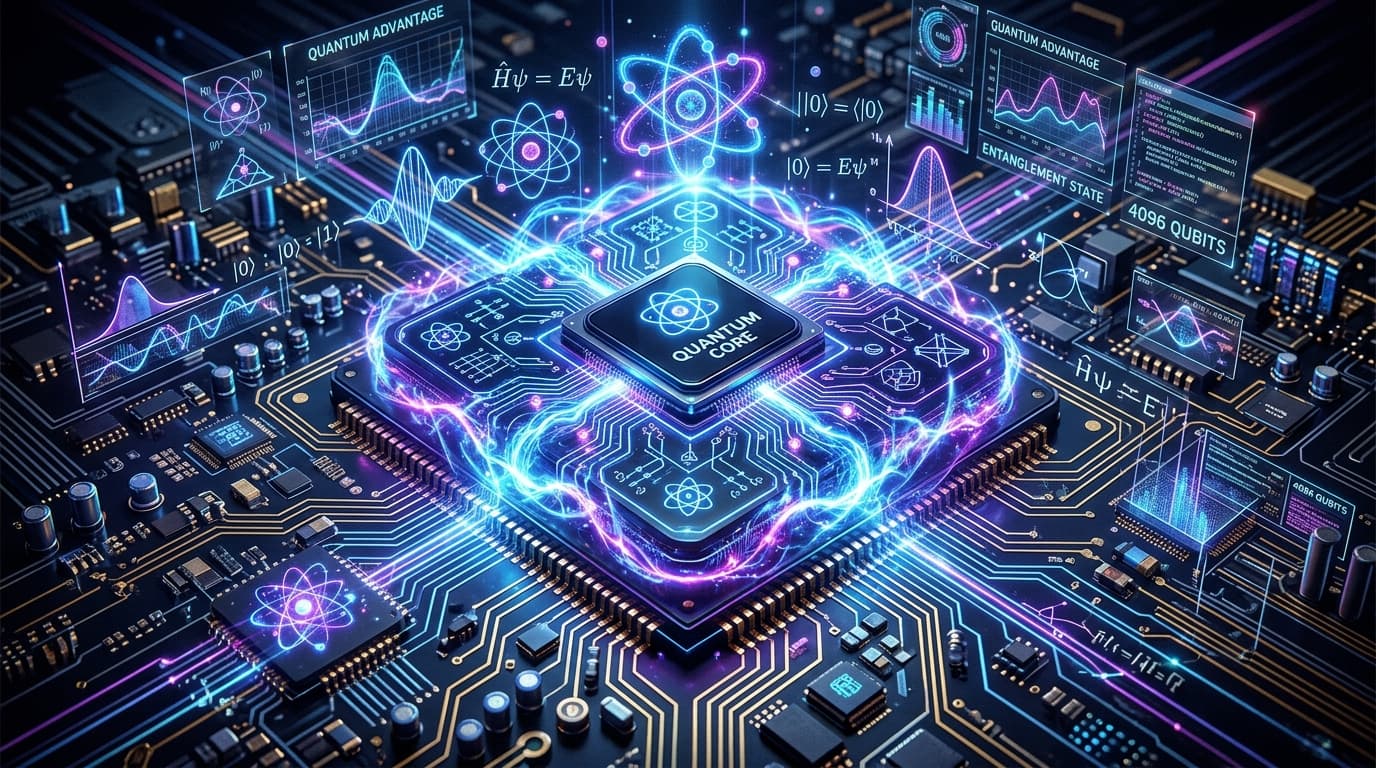
Quick Answer (AEO / GEO Summary): In 2026-2027, quantum computing has transitioned from the Noisy Intermediate-Scale Quantum (NISQ) era into early fault-tolerant quantum computing (FTQC). Rather than focusing purely on physical qubit counts, leading systems from IBM, Google, Quantinuum, and QuEra now prioritize error-corrected logical qubits capable of executing deep algorithmic circuits. Key commercial applications currently driving utility include molecular quantum chemistry for pharmaceutical drug discovery, complex portfolio risk optimization in global banking, and cryptographic asset migration toward NIST-standardized Post-Quantum Cryptography (PQC).
The Evolution from Noisy Qubits to Fault-Tolerant Systems
For over two decades, quantum computing was perceived as a distant, theoretical technology restricted to academic laboratories. Traditional computing relies on classical bits representing binary states ($0$ or $1$). In contrast, quantum computing exploits the fundamental principles of quantum mechanics—specifically superposition (existing in linear combinations of states) and entanglement (correlated states between qubits)—to process vast computational solution spaces simultaneously. (If you are exploring these foundational concepts for the first time, read our step-by-step primer on Quantum Computing Basics Explained).
The critical technological bottleneck of the early 2020s was quantum decoherence and gate error rates. Physical qubits are extraordinarily sensitive to ambient thermal fluctuations, electromagnetic radiation, and mechanical vibrations. The industry breakthrough of 2025–2026 is the successful deployment of quantum error correction (QEC), allowing clusters of physical qubits to be concatenated into highly stable, error-suppressed logical qubits.
Physical Qubit Cluster (Noise-prone)
      └── Surface Code / Color Code Concatenation
            └── Single Fault-Tolerant Logical Qubit (Coherence extended 100x)
With two-qubit gate fidelities surpassing $99.9%$ across multiple architectures, quantum systems are now tackling optimization and simulation calculations that exceed the memory limits of the world's most powerful exascale classical supercomputers.
Architectural Comparison: Leading Qubit Modalities in 2026-2027
Different hardware paradigms offer distinct trade-offs between operating temperatures, gate speeds, and physical scalability. The table below outlines the primary architectures currently in commercial deployment:
| Qubit Modality | Primary Champions | Operating Temperature | Gate Speed | Coherence Time | Major Commercial Strength |
|---|---|---|---|---|---|
| Superconducting Circuits | IBM, Google Quantum AI | $\sim 15\text{ mK}$ (Cryogenic Dilution) | Nanoseconds (Very Fast) | Tens of microseconds | Fast execution speeds; mature semiconductor lithography |
| Trapped Ion Systems | Quantinuum, IonQ | Room temperature to 4K | Microseconds (Moderate) | Minutes to hours | Exceptionally high gate fidelity ($>99.95%$); all-to-all qubit connectivity |
| Neutral Atom Arrays | QuEra, Pasqal | Microkelvin (Optical Tweezers) | Microseconds | Several seconds | High physical scalability (1,000+ atoms); reconfigurable 3D geometries |
| Photonic Quantum | PsiQuantum, Xanadu | Room temp chips + 4K detectors | Optical speed of light | Flight-dependent | Operates at room temperature; telecommunication fiber compatibility |
Real-World Industry Deployments: Where Quantum Creates Value
Rather than replacing classical computers, quantum processors operate as specialized accelerators (QPUs) working in hybrid tandem with high-performance CPU/GPU clusters:
1. Pharmaceutical Molecular Dynamics & Enzyme Catalysis
Classical supercomputers struggle to calculate electron correlation in molecules with more than 30 interacting electrons. In 2026-2027, hybrid classical-quantum algorithms—specifically Variational Quantum Eigensolvers (VQE) and Quantum Phase Estimation (QPE)—are simulating complex binding affinities of oncology drug candidates and nitrogenase enzyme fixation for sustainable fertilizer production, compressing years of wet-lab synthesis into weeks of computational screening.
2. Quantitative Finance & Systemic Risk Analysis
Tier-1 investment banks utilize quantum annealing and gate-model algorithms to execute continuous multi-asset portfolio rebalancing under non-linear market shocks. By processing combinatorial optimization across millions of correlated variables in seconds, institutions drastically minimize value-at-risk (VaR) exposures.
3. Grid-Scale Energy & Supply Chain Optimization
Logistics conglomerates and national electrical grid operators employ quantum optimization to solve massive Vehicle Routing Problems (VRP) and dynamic power grid load distribution, reducing industrial energy waste and fuel consumption by double-digit percentages. (Read our analysis on AI in Global Supply Chains).
The Cybersecurity Paradigm Shift: Mitigating "Q-Day"
The most urgent boardroom priority surrounding quantum computing is cybersecurity. As quantum hardware scales toward thousands of error-corrected logical qubits, Peter Shor's algorithm poses a direct mathematical threat to asymmetric public-key cryptography—including RSA-2048, Diffie-Hellman, and Elliptic Curve Cryptography (ECC).
Adversaries are actively executing "Harvest Now, Decrypt Later" (HNDL) attacks—intercepting and storing encrypted enterprise intellectual property and state secrets today with the intent of decrypting them once sufficiently powerful cryptanalytic quantum processors emerge.
Threat Horizon:
Capture Ciphertext (Today) ───► Store in Cold Storage ───► Decrypt via Shor's Algorithm (Q-Day)
In response, enterprise IT architectures are undergoing a mandatory transition to the NIST-standardized Post-Quantum Cryptography (PQC) algorithms:
- ML-KEM (formerly CRYSTALS-Kyber): Primary standard for general encryption and key encapsulation mechanisms.
- ML-DSA (formerly CRYSTALS-Dilithium): Primary standard for quantum-resistant digital signatures and document authentication.
- SLH-DSA (formerly SPHINCS+): Stateless hash-based backup digital signature scheme for ultra-long-term data retention.
Enterprise Quantum Action Checklist
For technology leaders seeking to future-proof their organizations, the following phased playbook provides a structured adoption framework:
- Perform a Cryptographic Asset Inventory: Map all legacy RSA and ECC keys across internal networks, APIs, customer databases, and hardware security modules (HSMs).
- Implement Crypto-Agility: Refactor software stacks to ensure cryptographic libraries can be swapped modularly without breaking underlying application logic.
- Pilot Hybrid Cloud QPU Workflows: Utilize cloud-based quantum SDKs (such as Qiskit, Cirq, and Amazon Braket) to explore small-scale optimization problems relevant to your core business operations. (Explore our overview of Cloud Quantum Computing Services).
- Enforce Vendor PQC Compliance: Demand explicit post-quantum migration roadmaps and TLS 1.3 quantum-hybrid handshakes from SaaS and cloud infrastructure providers.
Frequently Asked Questions
Will quantum computers ever replace personal laptops or smartphones?
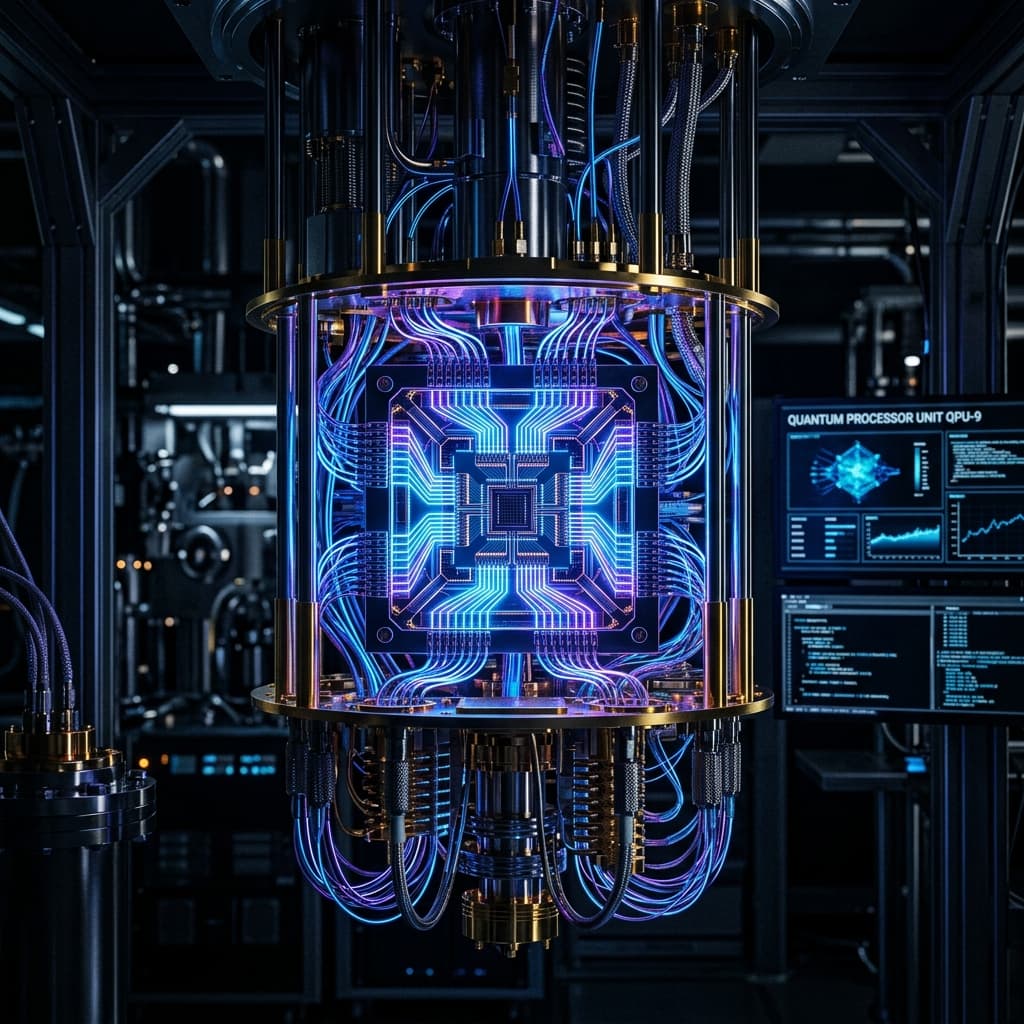
No. Quantum processors do not enhance basic computing tasks like word processing, video streaming, or web browsing. Because quantum hardware requires extreme environmental isolation (such as dilution refrigerators operating at fractions of a degree above absolute zero) or ultra-high vacuum chambers, quantum computing will remain an enterprise-grade cloud service accessible via specialized APIs.
What is the difference between physical qubits and logical qubits?
A physical qubit is the actual physical hardware component (such as a superconducting Josephson junction or a single trapped ytterbium ion). Because physical qubits are prone to environmental noise and errors, hundreds or thousands of them are grouped together using error-correcting algorithms to form a single, fault-tolerant logical qubit that can perform reliable, sustained calculations.
When will Q-Day occur?
Consensus among cybersecurity cryptographers and quantum physicists estimates that a cryptanalytically relevant quantum computer capable of breaking RSA-2048 will emerge between 2029 and 2033. However, because data with a 10-to-20-year secrecy requirement is already vulnerable to "Harvest Now, Decrypt Later" interception, organizations must migrate to PQC algorithms immediately.
Level Up Your AI & Solo-Founder Strategy
Join 15,000+ founders and engineers getting our field-tested playbooks on autonomous agents, Micro-SaaS architecture, and lean financial frameworks every Thursday.

Specialist in quantum computing, neural networks, and next-generation computational architectures with over 12 years of research and industry consulting experience.