Top 5 Upcoming Tech Gadgets That Will Change How You Live in 2026
The pace of technological innovation is moving faster than ever. What seemed like science fiction just a few years ago is now becoming our everyday reality. As we move deeper into 2026, a new wave of consumer technology is hitting the market, promising to reshape how we work, communicate, and manage our homes.
If you love staying ahead of the curve, here are the top 5 upcoming tech gadgets that are set to completely change your daily life.
1. Next-Generation Augmented Reality (AR) Glasses
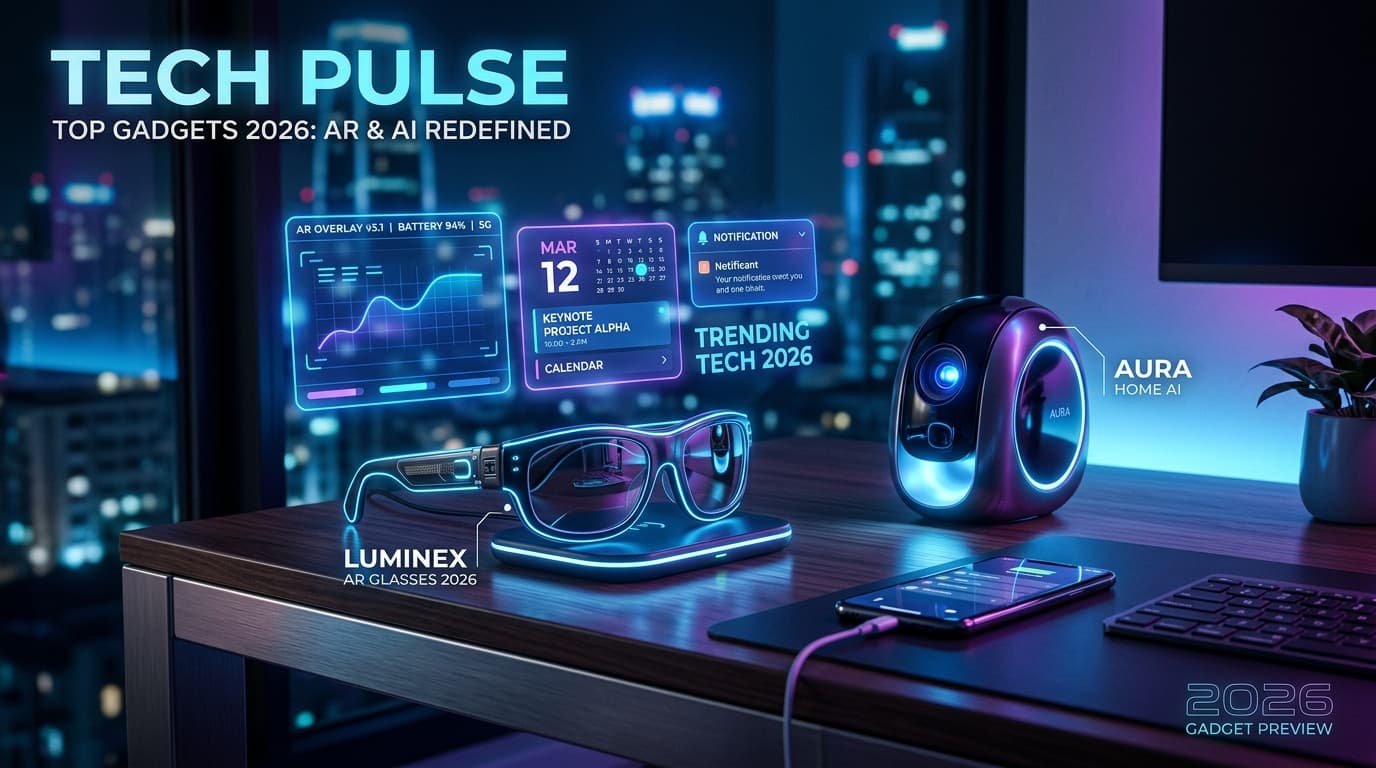
Forget the bulky headsets of the past. The AR glasses of 2026 look almost identical to regular prescription glasses or stylish sunglasses. These devices seamlessly overlay digital information onto the real world.
Imagine walking down the street and seeing navigation arrows projected onto the sidewalk, or glancing at a restaurant and instantly seeing its menu and reviews floating next to the door. These glasses also integrate with your smartphone, allowing you to read messages and take calls without ever looking down at a screen.
2. Personal AI Home Robots
While we’ve had robot vacuums for years, 2026 is the year of the true personal AI robot. These compact, autonomous assistants do much more than clean floors. Equipped with advanced vision AI and robotic arms, they can pick up clutter, organize objects, fetch items from another room, and even assist with basic meal prep.
Integrated with your smart home ecosystem, these robots learn your routines and anticipate your needs, essentially acting as a tireless household assistant.
3. Advanced Sleep Optimization Pods
Sleep technology has evolved far beyond simple trackers. The new trend for 2026 is the Sleep Optimization Pod—a smart mattress system that actively manages your sleep environment.
Using biometric sensors, these beds adjust their temperature, firmness, and even physical elevation in real-time based on your sleep stages. If you start snoring, the bed gently elevates your head. If your body temperature drops too low in deep sleep, it subtly warms up, ensuring you wake up feeling completely refreshed.
4. Holographic Desktop Displays
Monitors are finally evolving. Holographic desktop displays use advanced light-field technology to project true 3D images that you can interact with without needing special glasses.
For architects, designers, and engineers, this means manipulating 3D models with their bare hands. For the everyday user, it means an infinitely expansive digital workspace where windows and applications float in the physical space around your desk, boosting productivity to entirely new levels.
5. Neural Interface Wearables
Perhaps the most mind-bending gadget of 2026 is the non-invasive neural interface wearable. Worn like a sleek headband or even integrated into headphones, these devices read your brain's electrical signals to control software.
Want to skip a song on Spotify? Just think about it. Need to type a quick message? You can dictate it mentally. While still in its early consumer stages, this technology is bridging the gap between human thought and digital action.
Summary
The gadgets of 2026 are focused on one main theme: removing the friction between us and our technology. Whether it's AR glasses keeping our heads up, or home robots taking care of chores, these innovations are designed to make life smoother, smarter, and incredibly exciting.
Frequently Asked Questions (FAQs)
Are AR glasses safe for my eyes?
Yes, modern AR glasses use highly advanced micro-OLED displays that are calibrated to prevent eye strain and emit very low levels of blue light compared to traditional smartphones.
How much do personal home robots cost?
Prices vary, but entry-level home robots currently range between $800 to $1,500, similar to the price of a high-end smartphone or laptop.
Do I need special software for a holographic display?
Most holographic displays in 2026 are plug-and-play and compatible with standard operating systems like Windows and macOS, converting regular 3D software output into interactive holograms.